
An XAUUSD Trading Strategy for Beginners should not start with a chart full of indicators and dozens of entry conditions.
Gold can move quickly, react strongly to economic news, and produce large intraday swings. That makes simplicity and risk control especially important for someone learning how XAUUSD behaves.
XAUUSD represents gold priced against the U.S. dollar. Gold’s price can be influenced by monetary policy, economic data, the U.S. dollar, interest rates, and geopolitical developments. CME Group notes that gold traders need to pay attention to economic and political factors, including inflation indicators, Federal Reserve decisions, employment data, and global political stability.
The purpose of this XAUUSD Trading Strategy for Beginners is therefore not to predict every gold move.
Instead, the goal is to create a repeatable process:
Trend → Level → Pullback → Confirmation → Risk → Exit
That sequence gives a beginner a framework for deciding when to participate and when to stay out.
What Is XAUUSD?
XAUUSD is the commonly used market symbol for gold quoted against the U.S. dollar.
When XAUUSD rises, the quoted price of gold is increasing relative to the U.S. dollar. When it falls, the quoted price is decreasing.
For a beginner, the important point is that you are trading the price movement of gold against USD, not simply buying a physical gold bar.
Gold is also a major global market. CME describes its gold futures market as one of the world’s most actively traded gold markets, while noting that gold prices can respond to economic and political developments.
That is why an XAUUSD Trading Strategy for Beginners needs both technical structure and basic awareness of major market events.
You do not need to predict every macroeconomic event.
You do need to know when a major announcement could make your normal setup behave very differently.
Why Beginners Need a Simple Gold Trading Strategy
One of the biggest problems beginners face is trying to trade every movement.
Gold can create fast candles, sharp pullbacks, false breaks, and sudden changes in momentum. If you react to every movement, the number of decisions can quickly become excessive.
A better approach is to define a small number of conditions.
For example:
- What is the higher-timeframe direction?
- Where are the important levels?
- Has price reached one of those levels?
- Did a valid confirmation appear?
- Is the potential loss acceptable?
- Where is the trade invalidated?
This makes an XAUUSD Trading Strategy for Beginners easier to test because you can identify exactly why a trade was or was not taken.
The strategy below is intentionally based on conventional price structure, trend direction, support and resistance, confirmation, and risk management. It does not require complicated concepts to get started.
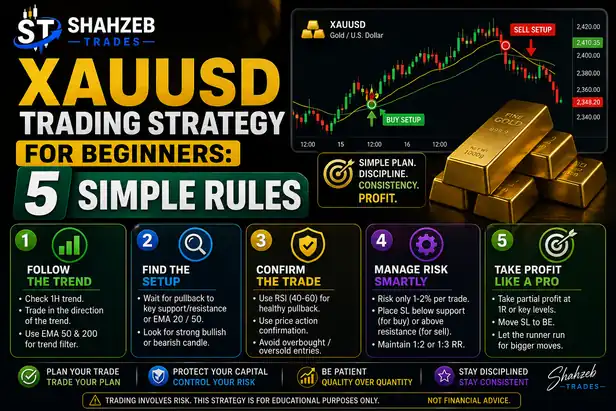
XAUUSD Trading Strategy for Beginners: 5 Simple Rules
1. Start With the Higher-Timeframe Trend
The first rule of this XAUUSD Trading Strategy for Beginners is to determine the broader market direction before looking for an entry.
A simple framework is:
1H chart: determine the main intraday trend.
15M chart: look for structure that agrees with the 1H direction.
5M chart: use the lower timeframe for entry confirmation.
For a bullish environment, you may see higher highs and higher lows on the higher timeframe.
For a bearish environment, you may see lower highs and lower lows.
The purpose is not to label every tiny movement.
You are trying to answer one question:
Is the market generally moving upward, downward, or sideways?
If the 1H chart is strongly bullish, a beginner can focus primarily on long setups instead of constantly switching between buy and sell ideas.
If the market is clearly bearish, the process can be reversed.
If the structure is unclear, doing nothing is a valid decision.
This is one of the most important principles in an XAUUSD Trading Strategy for Beginners: no clear direction means no obligation to trade.
2. Mark Important Support and Resistance
After identifying the trend, mark the levels where price has previously reacted.
Look for:
- Previous swing highs
- Previous swing lows
- Strong rejection areas
- Clear breakout levels
- Important intraday highs and lows
Do not cover the entire chart with lines.
The objective is to identify a few levels that actually matter.
For example, if gold is trending upward and price approaches a previous support area, you can start watching for a bullish reaction.
If gold is trending downward and price returns to a resistance area, you can watch for bearish confirmation.
This approach keeps the XAUUSD Trading Strategy for Beginners focused on location instead of chasing price in the middle of nowhere.
You can also combine your chart analysis with your Trading Tools workflow to keep levels and observations organized.
The key distinction is simple:
A level is an area of interest, not an automatic entry.
Price reaching support does not guarantee a bounce.
Price reaching resistance does not guarantee a rejection.
You still need confirmation.
3. Wait for a Pullback and Confirmation
This is where the XAUUSD Trading Strategy for Beginners becomes an actual entry model.
Suppose the 1H trend is bullish.
Instead of buying after a large bullish candle, wait for price to pull back toward an important support or structure area.
Then move to the 5M chart and wait for confirmation.
Possible confirmation can include:
- Bullish engulfing candle
- Strong rejection wick
- Break of a minor lower high
- Bullish market-structure shift
- Strong momentum candle from the level
For a bearish setup, reverse the logic.
The 1H trend should be bearish.
Price pulls back toward resistance.
Then the 5M chart provides bearish confirmation.
For example:
1H: Bearish structure
15M: Price approaching resistance
5M: Bearish rejection
Entry: After confirmation
Stop: Beyond the invalidation area
Target: Predefined support or planned risk-to-reward level
This is much different from simply seeing a red candle and selling.
Confirmation exists to reduce impulsive entries.
It does not eliminate losing trades.
4. Define Risk Before Entering
A strategy without risk management is incomplete.
Before entering an XAUUSD position, determine:
Entry: Where will the trade be executed?
Stop-loss: At what price is the setup invalid?
Position size: How much can you lose if the stop is reached?
Target: Where will you take the planned profit or exit?
The risk management part of your trading plan should be decided before clicking Buy or Sell.
For example, suppose an account is $1,000 and the trader chooses to risk 0.5% on one trade.
The maximum planned loss would be:
$1,000 × 0.5% = $5
The position size must then be calculated according to the broker’s XAUUSD contract specifications, stop distance, and tick or point value.
Do not copy a lot size from another trader.
Two traders can use the same entry and stop distance but have completely different account sizes and risk limits.
Gold’s volatility makes this especially important. CME’s educational material on precious metals risk management emphasizes that future prices are uncertain and that risk-management tools exist because market outcomes cannot be known with certainty.
The objective of an XAUUSD Trading Strategy for Beginners is not to make every trade profitable.
It is to ensure that one losing trade does not damage the account enough to disrupt the entire plan.
5. Use a Fixed Exit Plan
A beginner should decide the exit before entering.
There are several ways to structure an exit.
One approach is a fixed risk-to-reward model.
For example:
Risk: $10
Target: $20
Potential reward: 2R
Here, 1R represents the amount originally risked.
Another approach is using a nearby technical level as the target.
For a long position, that might be the next significant resistance.
For a short position, it might be the next significant support.
The important point is consistency.
Do not enter a trade with one target and then randomly move it because the position is losing.
Likewise, do not keep moving the target farther away simply because the trade is profitable.
An XAUUSD Trading Strategy for Beginners becomes easier to evaluate when the exit rules are predefined.
A Simple XAUUSD Trade Example
Consider this hypothetical example.
Gold is showing a bullish structure on the 1H chart.
The 15M chart shows price pulling back toward a previously respected support area.
You wait.
Price reaches the area.
On the 5M chart, a bullish rejection forms, followed by a candle that breaks a minor swing high.
The strategy now has its basic conditions:
Trend: Bullish
Location: Support
Pullback: Confirmed
Entry trigger: Bullish confirmation
Stop: Below the invalidation level
Target: Predefined resistance or planned R multiple
Notice what is missing.
There is no prediction that gold must rise.
The setup simply satisfies the conditions.
If price reaches the stop, the loss is accepted because the risk was predefined.
If price reaches the target, the trade is closed according to the plan.
That is how an XAUUSD Trading Strategy for Beginners should be evaluated: by the quality and consistency of the process rather than by one isolated result.
Best Timeframes for Beginners
There is no single universally “best” timeframe for XAUUSD.
The right timeframe depends on your trading style.
A simple multi-timeframe structure can be:
| Timeframe | Purpose |
|---|---|
| 1H | Main trend |
| 15M | Structure and setup location |
| 5M | Entry confirmation |
| 1M | Optional precise execution |
For a beginner, using too many timeframes can create confusion.
Start with three.
1H → 15M → 5M
The 1H chart gives context.
The 15M chart gives structure.
The 5M chart provides the entry trigger.
An XAUUSD Trading Strategy for Beginners should remain simple enough that you can explain every timeframe’s purpose in one sentence.
If you cannot explain why you are looking at a particular chart, you probably do not need it.
What Moves XAUUSD?
Technical analysis is only one part of gold trading.
Gold can react to macroeconomic and geopolitical developments.
CME specifically highlights U.S. monetary policy, inflation indicators such as CPI and PPI, employment data such as non-farm payrolls, and global political and economic stability as factors gold traders should monitor.
The U.S. dollar and interest-rate expectations are also important considerations.
This does not mean a beginner needs to predict every economic report.
Instead, check the economic calendar before trading.
If a major U.S. data release or central-bank decision is approaching, recognize that normal technical behavior can become less reliable during the event.
This matters even more for short-term traders.
For example, Reuters reported on August 25, 2026 that spot gold had recently reached around $4,696 before pulling back, with markets focused on inflation data and Federal Reserve communication.
That is a useful reminder that current gold price behavior can be strongly connected to macroeconomic expectations.
Do not build an XAUUSD Trading Strategy for Beginners around the assumption that technical patterns operate in isolation.
Common XAUUSD Trading Mistakes Beginners Make
Trading Every Candle
A large candle is not automatically an entry signal.
Wait for your predefined conditions.
Entering Without a Stop
A stop-loss should be part of the trade plan before entry.
Using Excessive Position Size
Gold’s movement can become uncomfortable quickly when position size is too large.
Reduce exposure rather than widening your emotional tolerance.
Chasing Breakouts
A fast breakout can tempt beginners to enter after the move has already occurred.
Wait for your defined confirmation instead of chasing price.
Ignoring Economic News
Major U.S. economic releases can affect gold volatility.
Check the calendar before the session.
Changing the Strategy After a Few Trades
Five trades are not enough to establish whether a strategy has an edge.
Test a meaningful sample under defined conditions.
Moving the Stop Because You Do Not Want to Lose
Moving a stop farther away changes the original risk.
If the setup is invalidated, accept the planned loss.
Trading When the Market Is Unclear
Not every session provides a clean trend.
Sometimes the best position is no position.
How to Practice This Strategy
Do not start by risking significant capital.
First, turn the XAUUSD Trading Strategy for Beginners into a written checklist.
Your checklist can look like this:
Before the Session
- Check major economic events.
- Identify the 1H trend.
- Mark important 15M levels.
- Decide which session you will trade.
- Define your maximum risk.
Before Entry
- Is the 1H direction clear?
- Is price at an important level?
- Did the 15M structure support the idea?
- Did the 5M confirmation appear?
- Is the stop logically placed?
- Is position size based on predefined risk?
- Is the target defined?
After Entry
- Do not increase risk impulsively.
- Do not move the stop farther away simply because price moves against you.
- Do not close the trade randomly because of fear.
- Follow the predefined management rules.
After the Trade
Record:
- Setup
- Entry
- Stop
- Target
- Result
- Risk
- Screenshot
- Rule followed?
- Rule violated?
- Emotional state
After enough samples, review the journal.
Look for patterns.
Maybe your best setups occur during a particular session.
Maybe your losses are concentrated around major news.
Maybe your entries are good but your exits are inconsistent.
That information is far more useful than simply looking at your total profit or loss.
FAQs
What is the best XAUUSD Trading Strategy for Beginners?
There is no universally best strategy. A practical starting framework is to identify the higher-timeframe trend, mark support and resistance, wait for a pullback, require lower-timeframe confirmation, and define risk before entering.
Is XAUUSD good for beginners?
There is no universally best strategy. A practical starting framework is to identify the higher-timeframe trend, mark support and resistance, wait for a pullback, require lower-timeframe confirmation, and define risk before entering.
Which timeframe is best for XAUUSD beginners?
A simple 1H, 15M, and 5M structure can be easier to manage than using many timeframes. The 1H can provide the broader direction, 15M can help identify structure, and 5M can provide entry confirmation.
What indicators should beginners use for XAUUSD?
Indicators are optional. A beginner can start with price structure, support, resistance, and a clear risk plan. If an indicator is added, understand exactly what information it provides rather than adding multiple indicators that duplicate the same information.
How much should I risk on XAUUSD?
There is no universal percentage that fits every trader. Your risk should account for your account size, strategy, stop distance, and financial situation. The important principle is to determine the maximum acceptable loss before entering and size the position accordingly.
Can I scalp XAUUSD using this strategy?
Yes, the framework can be adapted to shorter-term trading, but the lower the timeframe, the more sensitive execution becomes to spread, volatility, market noise, and fast price movements. Test the approach before using it with meaningful capital.
Should beginners trade XAUUSD during major news?
Beginners should be particularly cautious around major economic releases because volatility can increase rapidly. CME identifies U.S. monetary policy, inflation data, employment reports, and geopolitical developments among the factors gold traders should monitor.
Risk Disclaimer
Trading XAUUSD and other leveraged financial products involves substantial risk. A trading strategy cannot guarantee profits or eliminate losses. This article is for educational purposes only and is not personal financial advice. Before trading, understand your broker’s contract specifications, spreads, margin requirements, and execution conditions. Use appropriate risk management and only trade with capital you can afford to lose.
Conclusion
An effective XAUUSD Trading Strategy for Beginners does not need to be complicated.
Start with five rules:
1. Identify the higher-timeframe trend.
2. Mark important support and resistance.
3. Wait for a pullback and confirmation.
4. Define risk before entering.
5. Follow a fixed exit plan.
Then test the process over a meaningful sample.
Do not judge the strategy from one winning trade or one losing trade.
Gold can react sharply to technical and fundamental developments, so your strategy needs room for uncertainty rather than assuming every setup will work. CME’s gold-market education specifically emphasizes the importance of monitoring economic and political factors when trading gold.
The real objective of an XAUUSD Trading Strategy for Beginners is not to predict gold perfectly.
It is to create a repeatable decision-making process where you know when to enter, when not to enter, how much to risk, and when to exit.