
Table of Contents
Last Updated: August 2026
Introduction
How much to risk on a $100 forex account is one of the most important questions a new trader can answer before placing a live position. With only $100 available, even a few oversized losses can create a drawdown that becomes difficult to recover from.
A practical starting point is to define the dollar risk first and calculate the position size second. A 1% risk level on a $100 account equals $1 per trade. A 2% level equals $2. These percentages are commonly used as risk-management reference points, but they are not universal rules; CME Group explicitly describes the 2% threshold as an arbitrary trading convention and notes that traders can choose tighter or looser limits based on their approach.
In this guide, we will break down how much to risk on a $100 forex account, how to calculate lot size from your stop-loss, why 0.01 lots can still be too large for some setups, and how to handle losing streaks without changing your plan emotionally.
How much to risk on a $100 forex account
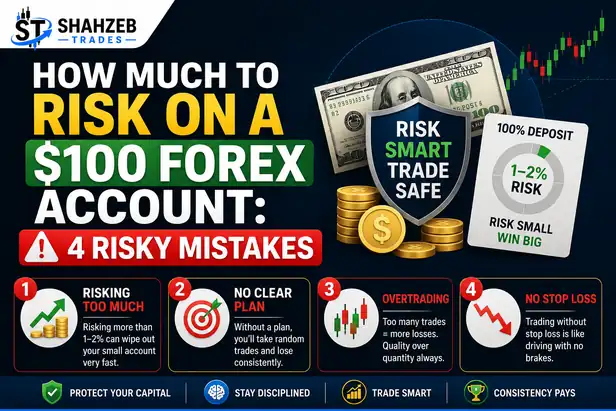
For most traders who are learning to manage a very small live account, a 1% risk per trade approach is a conservative starting framework. That means risking about $1 if the planned stop-loss is reached.
A 2% framework means risking $2 per trade. CME Group explains that fixed-percentage risk can help control losses during a losing streak because the dollar size of each new trade falls as the account falls.
| Risk per trade | Dollar risk on $100 |
|---|---|
| 0.5% | $0.50 |
| 1% | $1.00 |
| 1.5% | $1.50 |
| 2% | $2.00 |
| 3% | $3.00 |
| 5% | $5.00 |
| 10% | $10.00 |
So, when someone asks how much to risk on a $100 forex account, the more useful answer is not simply “risk 1%.” The real question is whether your broker, instrument, spread, stop-loss distance, and minimum position size allow you to keep the planned dollar risk within that range.
For a beginner asking how much to risk on a $100 forex account, 1% is often easier to work with because a losing trade costs less of the account and leaves more room to evaluate the strategy over a meaningful sample.
A simple starting framework
A practical framework could look like this:
- Conservative: 0.5% = $0.50
- Moderate: 1% = $1
- Upper guideline: 2% = $2
These are educational risk examples for readers comparing how much to risk on a $100 forex account, not guarantees about what is appropriate for every trader. The correct level depends on your strategy, trading costs, stop placement, and personal ability to absorb losses.
The 1% vs. 2% risk choice
The difference between 1% and 2% may sound small, but it compounds across a losing streak.
Suppose you start with $100 and use fixed percentage risk. After five consecutive losses:
At 1% risk, the balance would be about $95.10.
At 2% risk, the balance would be about $90.39.
CME Group demonstrates the same principle using larger account examples: reducing the percentage risk slows the account’s decline during consecutive losing trades.
When deciding how much to risk on a $100 forex account, the risk limit should not change because a setup looks especially attractive.
A common mistake is increasing risk after a loss because the trader wants to recover the money quickly. That changes the entire risk profile of the account. A disciplined approach keeps the percentage stable or reduces it when conditions become less favorable.
How much to risk on a $100 forex account with a stop-loss
How much to risk on a $100 forex account also requires understanding position sizing.
The basic calculation is:
Position size = Risk amount ÷ (Stop-loss distance × pip value)
For a USD-quoted major pair such as EUR/USD, a 0.01 lot position is commonly around $0.10 per pip, although exact pip value varies with the pair and account currency.
Knowing how much to risk on a $100 forex account tells you the cash limit, but it does not tell you what lot size to use. The stop-loss distance matters.
Imagine this setup:
- Account balance: $100
- Risk: 1%
- Risk amount: $1
- Stop-loss: 10 pips
- Approximate pip value: $0.10 per pip at 0.01 lots
Then:
10 pips × $0.10 = $1
That fits the 1% risk plan.
Now suppose the same trade requires a 25-pip stop.
25 pips × $0.10 = $2.50
The position would expose the account to roughly 2.5% before considering spread or execution differences. If your maximum planned risk is $1, the answer is not to move the stop closer just to make the trade fit. You would need a smaller position size, a different setup, or no trade.
This is the key idea behind how much to risk on a $100 forex account: the stop-loss should come from market structure and trade invalidation, while the position size should adapt to the stop.
If your platform does not support a small enough position size, the mathematically correct trade may be impossible at that account size.
Why 0.01 lots is not automatically safe
Many new traders hear “use 0.01 lots” and treat it as a universal small-account solution. That is flawed.
When you study how much to risk on a $100 forex account, remember that the lot size alone does not determine your account risk. Your stop-loss distance determines how much money can be lost if the trade reaches that stop.
For example, suppose 0.01 lots produces an approximate $0.10 pip value on EUR/USD:
- 10-pip stop = about $1 risk
- 20-pip stop = about $2 risk
- 30-pip stop = about $3 risk
- 50-pip stop = about $5 risk
On a $100 account, a 50-pip stop at that position size represents roughly 5% of the account.
That can make a setup far riskier than the trader intended.
This is why how much to risk on a $100 forex account should never be answered with a lot size alone. A better sequence is:
Account balance → risk percentage → dollar risk → stop-loss distance → position size
That sequence removes a lot of guesswork.
Five practical risk rules for a small forex account
1. Define the dollar risk before entry
Write the maximum loss in dollars before opening the trade.
For a $100 account, that could be $1 at 1% risk or $2 at 2%.
If the planned stop requires more than that, change the position size or skip the setup.
2. Keep your stop where the trade idea becomes invalid
Do not choose a stop only because a certain number of pips “fits” your account.
A technical stop might need to sit beyond a recent swing high, swing low, support area, or resistance area. The position size should then be calculated around that stop.
Your risk management framework should come before the entry, not after the loss.
3. Include trading costs
Spread, commissions, and slippage can affect your real result.
On a tiny account, even a relatively small transaction cost can represent a noticeable percentage of a $1–$2 planned risk. Investor.gov warns that transaction costs can turn otherwise favorable forex trades into losing transactions and also highlights the risks created by leverage.
4. Set a daily loss limit
A trade-by-trade limit is only part of the plan.
A trader using 1% per trade might set a maximum daily loss of 2% or 3%, then stop for the day once that limit is reached. The purpose is to prevent a short losing sequence from turning into emotional overtrading.
5. Reduce size when the account falls
If your balance drops from $100 to $90, 1% of the account is now $0.90, not $1.
This is what fixed-percentage sizing does: the dollar risk contracts as the account declines. It also means the position size should be recalculated rather than kept permanently fixed.
Keeping a simple record of risk, stop distance, lot size, and result can also reveal whether your execution matches your plan. Our trading tools section can be used alongside that process.
A worked EUR/USD example
Let’s make the calculation practical.
Assume:
- Balance = $100
- Risk = 1%
- Maximum loss = $1
- EUR/USD stop-loss = 20 pips
- Approximate value at 0.01 lots = $0.10 per pip
At 0.01 lots:
20 × $0.10 = $2
That is about 2% of the account, not 1%.
To risk exactly $1 with a 20-pip stop, the theoretical position size would be about 0.005 lots, assuming the pip-value assumption above.
But many brokers may impose a minimum volume or specific position-size increment that does not allow 0.005 lots. That creates an important small-account problem: the mathematically ideal position may not be available.
You then have three practical choices:
- Use a broker/account type that supports smaller position sizes.
- Find a valid setup with a stop distance that works with the minimum size.
- Do not take the trade.
The worst option is to force the trade and quietly accept a risk level that is far above your plan.
For traders still building consistency, reviewing your process through a trading psychology guide can also help because small accounts can create pressure to overtrade simply because the dollar amounts look small.
What about leverage on a $100 account?
When considering how much to risk on a $100 forex account, remember that leverage allows a trader to control a larger notional position with less margin.
Leverage and risk are related, but they are not the same thing.
Leverage can magnify both gains and losses. Investor.gov warns that leveraged forex trading can create large losses from relatively small market movements, including the possibility of losing the initial capital and, depending on the arrangement, more than that amount.
This means a broker offering high leverage does not mean you should use a large position.
For how much to risk on a $100 forex account, focus first on the cash amount you are prepared to lose if the stop is hit. Then calculate the position. Treat available leverage as a margin facility, not as a reason to increase exposure.
A trader can use high available leverage while keeping actual position risk small, or use modest leverage while still risking too much. For traders focused on how much to risk on a $100 forex account, the lot size and stop-loss determine the trade’s risk far more directly.
How to handle a losing streak
Small accounts can create a dangerous psychological cycle: loss, frustration, larger trade, larger loss, then even larger risk in an attempt to recover.
The math does not favor this approach.
If a $100 account loses 10%, it falls to $90. It then needs an 11.11% gain to return to $100.
After a 20% loss, the account is $80 and requires a 25% gain to recover.
After a 30% loss, the account is $70 and needs about a 42.86% gain to get back to the starting balance.
This is why controlled losses matter.
A fixed-risk plan can also make review more objective. Instead of asking, “How do I make the money back today?” you can ask:
- Did I follow my entry rules?
- Was the stop placed logically?
- Was position size correct?
- Did spread or slippage affect the result?
- Was the trade taken during the conditions my strategy actually targets?
That mindset keeps one losing trade from changing the rules for the next one.
FAQ
How much to risk on a $100 forex account per trade?
A cautious starting framework is 0.5% to 1% per trade, which is $0.50 to $1 on a $100 account. Some traders use up to 2%, or $2, but the appropriate level depends on the strategy, trading costs, stop-loss distance, and personal risk tolerance.
Is risking $5 on a $100 forex account too much?
Risking $5 on a $100 account means risking 5% on one trade. That is substantially more aggressive than a 1%–2% framework and can make a short losing streak cause a large drawdown. The dollar amount should be judged as a percentage of the account, not in isolation.
What lot size should I use on a $100 forex account?
There is no single correct lot size. It depends on the currency pair, stop-loss distance, pip value, and the dollar amount you are willing to risk. For example, 0.01 lots may risk about $1 on a 10-pip EUR/USD stop but about $3 on a 30-pip stop, before costs.
Can I risk 2% per trade on a $100 account?
Yes, 2% equals $2, and CME Group discusses 2% as a commonly used but discretionary risk-management threshold. It should be treated as a framework rather than a universal requirement. A lower risk level may be more appropriate for traders who are still testing a strategy.
How do I calculate forex lot size on a $100 account?
Start with your risk amount in dollars, then divide it by your stop-loss distance multiplied by the pip value:
Lot size = Risk amount ÷ (Stop-loss pips × pip value)
The exact result can differ by pair and account currency, so verify the pip value with your broker or position-size calculator before placing the order.
Risk Disclaimer
Trading forex involves substantial risk, and losses can occur. Past performance does not guarantee future results. The examples in this article are educational only and do not guarantee any particular outcome. Always use appropriate risk management and only trade with money you can afford to lose.
Conclusion
How much to risk on a $100 forex account comes down to one core principle: decide the percentage first, convert it into a dollar limit, and then size the trade around the stop-loss.
For many traders, 1% means a maximum planned loss of $1, while 2% means $2. The important part is consistency. A 0.01-lot position is not automatically low risk, and high leverage is not a reason to increase position size.
A small account is better treated as a test of process than a race to produce large dollar returns. Keep the risk controlled, calculate position size from the stop, account for trading costs, and review your execution over a series of trades when evaluating how much to risk on a $100 forex account rather than judging the method from one result.
For anyone researching how much to risk on a $100 forex account, the most useful habit is simple: know the dollar amount at risk before you click the order button.