
Table of Contents
- What Does It Mean to Be a Disciplined Trader?
- Why Trading Discipline Matters
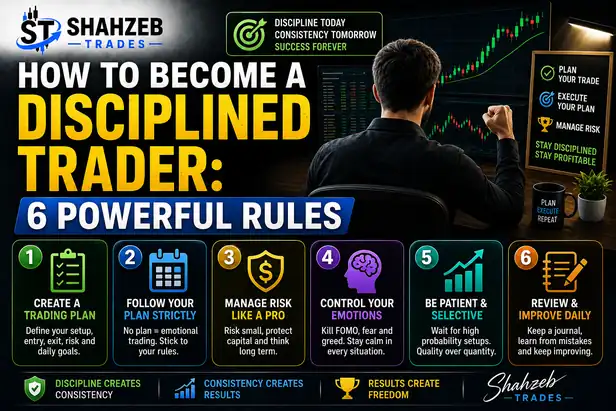
- How to Become a Disciplined Trader: 6 Essential Rules
- A Practical Example of Trading Discipline
- How to Become a Disciplined Trader During a Losing Streak
- How to Become a Disciplined Trader After a Winning Streak
- Build a Simple Daily Discipline Checklist
- Common Discipline Mistakes
- FAQs
- Risk Disclaimer
- Conclusion
How to Become a Disciplined Trader is less about having perfect self-control and more about building a system that makes disciplined behavior easier to repeat. A trader can know exactly what the plan says and still break it when a position moves quickly, a loss feels frustrating, or a winning streak creates confidence.
Trading discipline is visible in actions: taking only planned setups, keeping risk consistent, accepting predefined losses, avoiding impulsive entries, and reviewing decisions honestly.
CME Group’s trading-psychology material emphasizes that traders need to understand their own psychological barriers and build a trading plan suited to their personality and risk attitude. Its trade-plan guidance puts objectives, methodology, risk management, trading strategies, and a trader log into the planning process. CME Group’s Trading Psychology course and CME’s trade-plan framework provide useful first-party references.
This guide explains How to Become a Disciplined Trader through six practical rules you can apply before, during, and after a trading session.
What Does It Mean to Be a Disciplined Trader?
A disciplined trader is not someone who never feels fear, excitement, frustration, or hesitation.
A disciplined trader is someone who has rules for what to do when those emotions appear.
That distinction matters.
Suppose your trading plan says to risk a predefined amount, enter only when specific conditions appear, and stop after a daily loss limit. A difficult market session arrives. Price moves quickly and you feel pressure.
Discipline means the process remains the same.
Without that structure, decisions can start changing from one trade to the next.
One important idea in How to Become a Disciplined Trader is pre-commitment: make the major decisions before the market creates emotional pressure.
You decide what qualifies as a trade before the chart starts moving quickly. You decide what amount you are prepared to risk before the position is opened. You decide what conditions make you stop before you are frustrated.
That leaves less room for improvisation when your emotions are strongest.
Why Trading Discipline Matters
Markets are uncertain. Even a well-researched trade can move in the opposite direction.
That means a trader needs a process that does not depend on being right every time.
CME Group explains that losing is part of trading and that psychological barriers can influence decision-making. Its educational material also stresses the importance of developing a trading plan that is unique to the trader. CME’s personality and trade-plan guidance explains how personality, motivation, risk attitude, and available resources can influence the structure of a trade plan.
The practical lesson is simple: if your rules only work when you are calm and profitable, they are not strong enough for difficult market conditions.
This is where How to Become a Disciplined Trader becomes a process question rather than a motivation question.
You are not asking yourself to “try harder.”
You are building a system that makes the correct behavior easier to repeat.
How to Become a Disciplined Trader: 6 Essential Rules
1. Define Your Trading Rules in Writing
The first rule in How to Become a Disciplined Trader is to stop relying on memory.
Write the rules down.
Your plan should answer:
- What markets do I trade?
- Which sessions do I trade?
- What qualifies as a setup?
- What invalidates the setup?
- Where is the stop?
- How is position size calculated?
- What is my maximum daily loss?
- When do I stop trading?
CME Group describes a trading plan as a working document covering major parts of a trader’s approach, including objectives, methodology, risk management, strategies, and a trader log. Building a Trade Plan provides that framework.
Written rules create a reference point.
If the rule is “enter when conditions A, B, and C are present,” you do not need to invent a new interpretation because price looks exciting.
That is a major part of How to Become a Disciplined Trader: replace improvisation with predefined conditions.
Your rules should also define what you will not trade.
For example, if your setup requires a specific trend and confirmation, a nearly identical pattern without confirmation is not close enough. It is simply outside the plan.
2. Make Risk Boring
A trader who is emotionally attached to every dollar will struggle to follow a plan.
Risk should therefore be defined before entry.
For example, suppose an account is $2,000 and the trader decides that the planned risk on one trade is 1%.
The calculation is:
$2,000 × 1% = $20
The next step is to calculate a position size that fits the chosen stop distance and the instrument’s value per pip or point.
CME Group’s position-sizing guidance explains that position size should be connected to account risk and stop distance. CME position-sizing guidance provides the underlying framework.
The exact percentage is not the important lesson here.
Consistency is.
If one trade risks $20, the next risks $20, and the third suddenly risks $100 because the setup “looks perfect,” the process has already changed.
Your risk management framework should therefore sit underneath the entire plan.
When risk is controlled, it becomes easier to think about execution instead of constantly calculating what the next candle could do to the account.
A useful test for How to Become a Disciplined Trader is simple:
Would I still take this position if I knew the next five candles would be uncomfortable?
If the answer is no, the position may be too large for the plan.
3. Create an A-Setup Standard
One major discipline problem is treating every movement as a trade.
A disciplined trader defines what qualifies and rejects everything else.
Create a checklist with three to five conditions.
For example:
- Market context matches the strategy.
- Setup structure is present.
- Entry trigger is confirmed.
- Risk is within the predefined limit.
- No planned rule has been violated.
If one important condition is missing, there is no trade.
This approach makes How to Become a Disciplined Trader much more concrete because the decision becomes binary: the setup qualifies or it does not.
You are not trying to find reasons to enter.
You are checking whether the market has met your conditions.
CME’s trading-strategy guidance recommends establishing clear entry and exit criteria and writing down the exact conditions required before entering or exiting. CME strategy planning covers this approach.
A strict checklist also protects you from FOMO.
When price suddenly moves without giving your required trigger, you do not have to invent a new setup. You already know the answer: wait.
4. Separate Losing From Being Wrong
A losing trade can be correctly executed.
That is one of the hardest ideas for new traders to accept.
Imagine the strategy requires a trend, a specific trigger, a defined stop, and fixed risk. You follow every condition and the stop is hit.
The result is negative.
But the decision can still have been disciplined.
Now reverse it.
A trader ignores the setup, increases size, and enters randomly. Price immediately moves in the expected direction.
The result is positive.
The process is still weak.
How to Become a Disciplined Trader requires learning to judge the decision separately from the result.
After each trade, ask:
Did I follow the plan?
Then ask:
Did the market simply produce a losing outcome that was possible under the plan?
This prevents a single result from rewriting the strategy.
CME Group’s psychology material makes a similar distinction by emphasizing the difficulty of handling losses and the importance of a plan that supports better decisions under pressure.
A disciplined review might therefore look like this:
Good process + losing result = review the market outcome.
Poor process + winning result = review the behavior.
That is much more useful than labeling every winner “good” and every loser “bad.”
5. Build Rules for Your Emotional Triggers
Different traders have different triggers.
One trader becomes impulsive after a loss.
Another becomes overconfident after several wins.
Another struggles when price moves quickly and fears missing the entry.
Identify your pattern.
Keep a journal with four useful fields:
Trigger: What happened?
Emotion: What did I feel?
Impulse: What did I want to do?
Action: What did I actually do?
After enough trades, recurring patterns become easier to see.
For example:
Trigger: First losing trade
Emotion: Frustration
Impulse: Increase size
Action: Closed platform
That final action is what matters.
The aim of How to Become a Disciplined Trader is not to prevent the emotion from appearing. It is to create a better response when it appears.
CME’s trader guidance also recommends checking your mental and emotional state as part of a trading routine and understanding how your personal condition can affect decisions. CME trader tips provides related guidance.
Do not simply write “I was emotional.”
Be precise.
Was it fear of another loss?
Was it frustration over a missed setup?
Was it excitement after a strong move?
Was it pressure to finish the day positive?
Specific labels make specific rules possible.
6. Review Your Process Every Week
Daily trading can make short-term results feel bigger than they are.
A weekly review creates distance.
Do not review only profit and loss.
Review:
- Number of planned trades
- Number of unplanned trades
- Rule violations
- Risk changes
- Stop adjustments
- Revenge entries
- FOMO entries
- Missed valid setups
- Trades taken outside the planned session
Then identify the most common issue.
Do not try to fix ten behaviors at once.
Choose one.
For example:
This week I will focus only on avoiding unplanned entries.
That makes How to Become a Disciplined Trader measurable.
You can track whether the behavior improved rather than relying on the feeling that you are “more disciplined.”
CME Group’s trade-plan material treats the trading log as part of the overall plan, reinforcing the idea that review belongs inside the process rather than being an afterthought.
A Practical Example of Trading Discipline
Imagine a trader has a $5,000 account.
Before the session, the trader writes:
Risk per trade: 0.5%
Daily loss limit: 1.5%
Maximum setups: determined by the strategy
Required setup: all checklist conditions must be present
The first trade loses.
The trader feels frustrated.
A second opportunity appears, but one required condition is missing.
The trader stays out.
Later, a valid setup appears.
The trader takes it using the same predefined risk.
Whether that trade wins or loses is separate from the discipline decision.
The disciplined behavior occurred when the trader rejected the incomplete setup.
That is the type of behavior a journal should capture.
How to Become a Disciplined Trader is therefore not about producing a perfect record of winning trades.
It is about creating consistency in decisions.
The example also shows why risk and discipline should be connected. When the rules define the acceptable amount of exposure before the trade, there is less room for a frustrated trader to change size after the first outcome.
How to Become a Disciplined Trader During a Losing Streak
A losing streak can challenge even a well-structured process.
The first mistake is changing everything immediately.
Instead, separate three questions:
Was the strategy followed?
Was risk controlled?
Were the losses within the strategy’s expected behavior based on your own testing?
If the rules were followed, avoid turning frustration into a new strategy.
If rules were repeatedly broken, focus on the behavior first.
For example, if five trades were planned but three were impulsive, the first problem is not necessarily market analysis. It may be execution discipline.
The CFTC advises traders to determine how much risk capital they can use and develop a risk-management plan. It also warns about the substantial risks associated with leveraged forex trading. CFTC forex guidance provides official information for traders.
A useful How to Become a Disciplined Trader rule during a difficult streak is to protect the process before protecting the day’s P&L.
That means:
- Do not increase risk to recover a loss.
- Do not add trades simply because the previous ones failed.
- Do not abandon your setup checklist because you are frustrated.
- Review the sample before changing the strategy.
A losing streak should trigger evaluation, not automatic escalation.
How to Become a Disciplined Trader After a Winning Streak
Winning streaks can create their own psychological problem.
A trader may start believing that the next setup deserves more risk.
That assumption needs to be challenged.
Ask:
Would I take this trade with exactly the same size if the previous trade had lost?
If the answer is no, the previous result is influencing the current decision.
A disciplined trader can finish a profitable session without changing the rules because of temporary confidence.
This is particularly important because recent success can hide process problems.
A weak decision that happens to work is still a weak decision.
How to Become a Disciplined Trader means keeping the decision framework stable during both good and bad periods.
Your standards should not rise only after losses or disappear after wins.
Build a Simple Daily Discipline Checklist
Before the session:
Market: What am I trading?
Setup: What exactly am I waiting for?
Risk: What is my maximum planned exposure?
Stop: Where is the trade invalidated?
Limit: What ends the session?
Emotion: What behavior do I need to watch today?
Before every order:
Does the setup qualify?
Is the risk correct?
Am I following the plan?
Am I reacting to the previous trade?
After the session:
How many trades followed the plan?
How many did not?
What was the main behavioral mistake?
Your Trading Tools can help organize this checklist and keep the review process consistent.
For How to Become a Disciplined Trader, the checklist should be short enough that you will actually use it during a live session.
A checklist that takes two minutes and gets used consistently is more useful than a 30-point document that stays closed.
Common Discipline Mistakes
Changing Rules Mid-Trade
A plan loses its usefulness when the rules change because the open position feels uncomfortable.
Increasing Size After a Loss
The previous loss does not improve the next setup.
Increasing Size After a Win
The previous win does not make the next setup safer.
Trading Because You Are Bored
A quiet chart is not automatically an opportunity.
Chasing a Missed Entry
Missing one setup does not mean the next price movement needs to be traded.
Strategy Hopping After a Few Losses
A small sample may not tell you whether the strategy is valid. Review the testing and execution before making major changes.
Measuring Discipline Only by Profit
Profit and discipline are different measurements.
A profitable trade can come from poor execution. A losing trade can come from correct execution.
This distinction is central to How to Become a Disciplined Trader because behavior should be evaluated independently from the emotional satisfaction of the result.
FAQs
How to Become a Disciplined Trader if I keep breaking my rules?
How to Become a Disciplined Trader starts with making your rules specific enough to verify. Write down your setup, risk limit, stop rule, and session limit. Then record every rule violation. Focus on reducing one repeated violation at a time instead of trying to change your entire behavior immediately.
How many trades should a disciplined trader take?
There is no universal number that defines discipline. The appropriate number depends on the strategy and its rules. A disciplined trader may take several trades when each one qualifies, while another may take very few. The key question is whether each trade follows the plan rather than the raw trade count.
How do I stay disciplined after a losing trade?
Use a predefined response. Review whether the trade followed your rules, avoid increasing risk simply to recover the loss, and wait for the next valid setup. A cooling-off period can also be included in your plan if losses tend to trigger impulsive decisions.
Can a trader be disciplined and still lose money?
Yes. Discipline describes how consistently you follow the trading process; it does not determine the outcome of every individual trade. A valid setup can lose, while an unplanned trade can occasionally make money. Evaluate execution, risk, and adherence to the plan rather than using one result as the measure of discipline.
Should I change my strategy after several losses?
Not automatically. First review whether the strategy was executed correctly and whether the sample is large enough to evaluate the approach. Changing methods after a small number of outcomes can make it difficult to determine whether the issue was the strategy, the market environment, or your execution.
What is the best way to track trading discipline?
A trading journal is one practical method. Record planned versus actual trades, risk, rule violations, emotional triggers, and the reason for each entry and exit. Review the data weekly and choose one behavior to improve. CME Group also includes a trader log within its trade-plan framework.
Risk Disclaimer
Trading and leveraged financial markets involve substantial risk. No discipline system can remove market uncertainty or guarantee a particular result. This article is for educational purposes only and is not personal financial advice. Use appropriate risk management, understand your broker’s terms and costs, and trade only with capital you can afford to lose.
Conclusion
How to Become a Disciplined Trader is not about trying harder every morning.
It is about building a process that still works when you are frustrated, excited, nervous, or disappointed.
Write the rules.
Define risk before entry.
Trade only qualified setups.
Separate trade results from decision quality.
Track your emotional triggers.
Review your behavior every week.
The goal is not to become a trader who never feels pressure.
The goal is to become a trader who knows what to do when pressure appears.
That is what real discipline looks like in practice: fewer improvised decisions, clearer boundaries, and a process that can be reviewed and improved over time.
The answer to How to Become a Disciplined Trader is not one mindset trick. It is the repeated application of small rules that protect your decision-making when the market becomes uncomfortable.