
Table of Contents
Last Updated: September 22, 2026
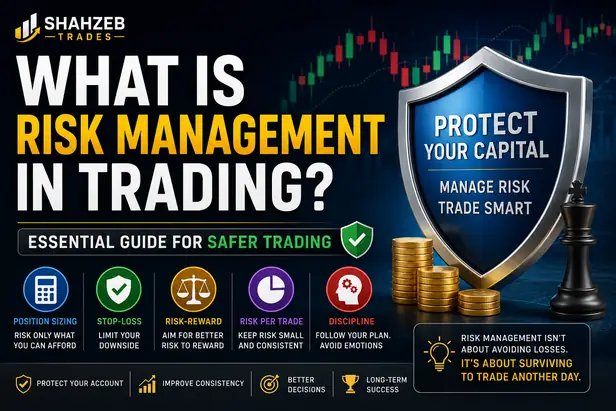
What Is Risk Management in Trading? It is the process of deciding how much money can be exposed before a trade and how that exposure will be controlled if the idea fails.
A strategy finds an opportunity. Risk management decides position size, invalidation, and when trading should stop.
Why Risk Management Matters
What Is Risk Management in Trading becomes clearer when you stop trying to predict every market move. Breakouts fail, support breaks, and news can move price quickly. Even a setup that follows your rules can lose.
The useful response is to control the damage from losing trades.
The CFTC advises forex traders to use risk capital and a risk-management plan. Its current advisory also warns about the risks of leveraged OTC forex.
Four Parts of a Risk-Controlled Trade
Risk management can be reduced to four questions:
- How much can I lose?
- Where is my trade idea invalid?
- What position size fits that stop?
- When does the trade or session end?
Answer these before opening the order.
How Position Sizing Controls Risk
Position size should follow the risk plan.
Imagine a $2,000 account with a 1% planned risk. The intended loss is $20 before spread, commission, slippage, and execution differences.
If Setup A needs a 20-pip stop and Setup B needs a 50-pip stop, they should not automatically use the same position size. The wider stop generally requires less exposure when dollar risk stays constant.
Use the Shahzeb Trades Forex Lot Size Calculator and verify the result with your broker.
Stop-Loss: Define the Invalidation Point
A stop-loss is not simply a fixed distance from entry.
First identify where the trade idea becomes invalid. A breakout may fail back through the broken level. A pullback may fail beyond the relevant swing.
That invalidation point determines the stop distance, and position size adapts to it.
What Is Risk Management in Trading should connect analysis and exposure in this order:
Trade idea → invalidation → stop distance → position size → dollar risk
A stop cannot guarantee an exact execution price. Fast markets, gaps, and slippage can change the final result.
Set a Maximum Daily Loss
Per-trade risk controls one position. A daily loss limit controls the session.
Suppose planned risk is $20 per trade and the daily boundary is $60. After three full-risk losses, the plan says trading stops.
The purpose is to prevent frustration, revenge trading, or repeated low-quality entries from expanding a bad session.
Control Total Exposure
Several small positions can create one large market bet.
Multiple USD-related trades may react to the same U.S. data, making combined exposure larger than it appears.
Track open positions, combined risk, and correlated exposure before adding another trade.
Leverage and Margin
Leverage allows a trader to control a larger position with less capital posted as margin. It can increase the financial effect of price movements.
High available leverage is not a reason to increase position size.
The CFTC explains that OTC forex uses margin and warns that leverage can magnify gains and losses. Investor.gov also explains that leveraged trading can create substantial losses relative to the capital used.
What Is Risk Management in Trading should therefore treat leverage as an exposure variable, not a profit target.
Common Risk Management Mistakes
Oversizing one trade can create a large drawdown.
Increasing size after a loss turns the next position into a recovery attempt.
Moving the stop farther away changes the original risk.
Taking too many trades can increase total exposure and trading costs.
Ignoring spread, commission, swap, and slippage can make actual results differ from the plan.
A Simple Personal Risk Plan
Before the session, write your maximum risk per trade, daily loss limit, open exposure, stop method, position-size method, and conditions that end trading.
CME Group’s trade-plan framework recommends considering risk tolerance, intended leverage, maximum trade loss, maximum day loss, number of positions, and maximum account exposure.
For a detailed small-account example, see How Much to Risk on a $100 Forex Account.
For beginners, What Is Risk Management in Trading should start with these rules rather than a complicated system.
A Practical $5,000 Example
Account: $5,000
Planned risk: 1%
Maximum planned loss: $50
Setup A has a 25-pip stop.
Setup B has a 50-pip stop.
If both trades use the same $50 risk, Setup B generally needs a smaller position because its stop is twice as wide.
That is the central calculation: the position changes to fit the risk.
How to Review Your Risk
A journal should record more than profit and loss.
Track account balance, risk percentage, dollar risk, stop distance, position size, setup type, session, result, trading costs, and rule violations.
After 20–30 trades, review whether losses came from the market or poor execution.
Did you exceed planned risk?
Did you move stops?
Did you add exposure after a loss?
For more detail, see Forex Risk Management.
FAQs
What Is Risk Management in Trading in simple terms?
It is the process of controlling potential trading losses through predefined risk, position sizing, stop-loss placement, leverage limits, exposure limits, and trading rules.
How much should I risk per trade?
There is no universal percentage. A small, predefined portion of account equity is a common approach, but the appropriate level depends on the strategy, account, costs, and personal circumstances.
Does a stop-loss guarantee my exact loss?
No. A stop can help define planned risk, but fast markets, gaps, slippage, and execution conditions can affect the final result.
Conclusion
What Is Risk Management in Trading is ultimately a question about survival and process.
Define the loss before the order. Let market structure determine the stop. Let the stop distance determine position size. Control leverage and combined exposure. Review your behavior after a meaningful sample.
The goal is not to avoid every losing trade.
It is to make sure one trade, one session, or one emotional decision does not control the account.
Risk Disclaimer: This article is for educational purposes only and is not financial advice. Forex, Gold, CFDs, futures, and other leveraged products involve substantial risk of loss. Broker rules, margin requirements, spreads, commissions, and execution conditions vary. Risk controls cannot eliminate market losses or guarantee results. Never trade with money you cannot afford to lose.