
Table of Contents
What Is Forex Risk Management?
Forex Risk Management is the process of deciding how much capital you are willing to expose to a trade and how you will control that exposure before the position is opened.
A trading setup can look attractive, but the setup itself does not determine how much money should be placed at risk. Position size, stop-loss distance, leverage, account size, and daily loss limits all play a role.
A useful way to think about Forex Risk Management is simple:
First control the amount you can lose. Then focus on the trade idea.
This approach changes the way you build a trading plan. Instead of deciding the lot size first and trying to fit the stop around it, you start with the amount you are prepared to risk and then calculate the appropriate position size.
For traders learning the basics, this is one of the most important habits to develop.
Why Forex Risk Management Matters
Forex trading commonly involves margin and leverage. That means a relatively small amount of account capital can control a much larger position. The same mechanism that increases exposure can also increase losses when the market moves against a position. The CFTC specifically warns that leveraged OTC forex trading can result in losses that exceed the amount initially deposited in some circumstances.
That makes Forex Risk Management more than a spreadsheet exercise.
Consider two traders who take the same setup.
Trader A risks a controlled amount on every trade.
Trader B changes position size based on confidence and recent results.
Even if they take identical entries, their account paths can be completely different.
Good risk management does not remove market uncertainty. Its purpose is to keep one trade, one bad session, or one poor decision from creating damage that is difficult to recover from.
CME Group’s educational material similarly emphasizes determining position size from the planned stop and the amount of account capital the trader is willing to risk.
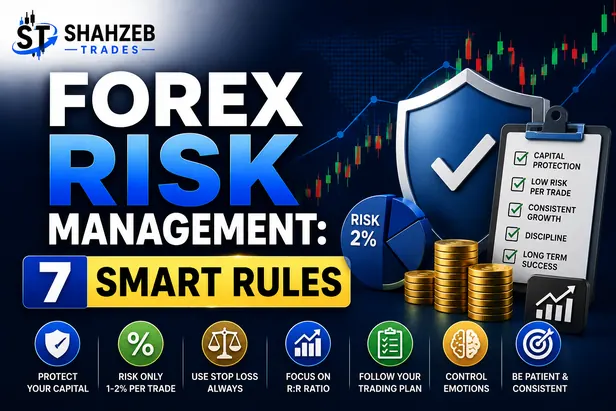
The 7 Core Rules of Forex Risk Management
1. Decide Your Risk Before the Trade
The first rule is to define the maximum planned loss before entering.
For example, suppose your account is $2,000 and you choose to risk 1% on a trade.
The calculation is:
$2,000 × 1% = $20
Your planned risk is therefore $20.
This does not mean every trade will lose exactly $20. Slippage, spread, execution conditions, and market gaps can affect actual results.
The important point is that you started with a predefined risk amount rather than choosing a position size emotionally.
CME Group recommends considering account size and the amount of capital you are willing to risk when determining position size.
2. Use Position Size to Control Dollar Risk
Position sizing connects your account risk to the trade’s stop distance.
A simplified framework is:
Position Size = Risk Amount ÷ Risk Per Unit
In practice, forex traders often use a lot-size or position-size calculator because pip value depends on the currency pair, account currency, and position size.
Here is the idea with a simplified example:
- Account size: $2,000
- Planned risk: 1%
- Maximum planned loss: $20
- Stop distance: 20 pips
The goal is to choose a position size where a 20-pip move to the stop represents approximately $20 of planned loss.
If you move the stop farther away, the position size generally needs to become smaller to maintain the same dollar risk.
If the stop becomes tighter, the position size may need to decrease or increase depending on the instrument’s pip value and the chosen risk amount.
This is why lot size should come after the risk calculation.
For a deeper look at position planning, you can also review risk management principles and use suitable trading tools when calculating trade size.
3. Place the Stop at a Logical Level
A stop-loss should not simply be placed at an arbitrary number because a certain percentage sounds comfortable.
The stop should make sense relative to the trade idea.
For example, if you enter after a breakout, the stop could be placed beyond the area that would invalidate the setup. If you enter after a pullback, the stop may sit beyond a structural level that tells you your original idea is no longer valid.
CME Group notes that stops should be placed at logical levels rather than random prices and should account for normal market movement.
The key relationship is:
Trade idea → logical invalidation level → stop distance → position size
Not:
Desired lot size → random stop
That small change in thinking can make a trading plan much more consistent.
4. Set a Daily Loss Limit
One losing trade does not always create the biggest problem.
Sometimes the bigger issue is what happens afterward.
A trader loses one position, increases size on the next trade, takes another setup immediately, and then continues trading because the first loss feels unacceptable.
A daily loss limit creates a clear stopping point.
For example, a trader might decide:
Maximum daily loss = 2R
Here, R means the amount planned to lose on one trade.
If 1R equals $20, then 2R equals $40.
After reaching that limit, the trader stops for the day.
The exact limit is a personal choice and should fit the trading strategy, account size, and experience level. The important part is deciding the rule before emotions become involved.
5. Respect Leverage and Margin
Leverage can make a small account look capable of controlling a much larger position.
That is precisely why it requires careful attention.
Margin is not the same thing as risk.
A broker may allow you to open a position using a relatively small amount of margin, but the market exposure can be much larger.
The CFTC explains that leverage can amplify both gains and losses and that margin requirements determine how much capital may be needed to open and maintain a position.
A common beginner mistake is asking:
“How much can I open?”
A better question is:
“How much exposure should I take?”
Those are very different questions.
Your broker’s leverage setting should never become the reason to increase your trade size.
6. Avoid Revenge Trading
Risk management is not only mathematical.
It is behavioral.
After a loss, traders can feel pressure to recover the amount immediately. That can lead to larger positions, weaker setups, or multiple entries within a short period.
This is where a written trading plan becomes valuable.
A simple rule could be:
After reaching the daily loss limit, stop trading and review later.
Another rule could be:
Never increase position size simply because the previous trade lost.
The objective is to make each new decision independent from the emotional result of the previous trade.
If psychology is becoming a repeated issue, learning the basics of trading psychology can complement your risk framework.
7. Review Your Risk, Not Just Your Results
Many traders review their week by asking:
“How much money did I make?”
That matters, but it is not enough.
Also ask:
- Did I follow my risk limit?
- Did I move stops without a valid reason?
- Did I increase size after a loss?
- Did I take trades outside my plan?
- Did I expose too much capital to one market?
- Did spread or volatility change the trade’s expected cost?
This turns your trading journal into a risk-control tool rather than just a profit-and-loss record.
A trader can have a profitable week with poor risk habits. That does not automatically make those habits sound.
Conversely, a losing week can still show good discipline if every trade followed the planned risk framework.
The goal is to evaluate the process, not just the final number.
A Simple Forex Risk Management Example
Let’s build a straightforward example.
Suppose:
- Account size = $5,000
- Planned risk per trade = 1%
- Risk amount = $50
- Entry = based on your trading setup
- Stop distance = 25 pips
The first calculation is:
$5,000 × 1% = $50
So the maximum planned risk is $50.
Next, determine the position size that makes a 25-pip stop approximately equal to that $50 risk for the pair being traded.
The exact lot size cannot be selected safely from the account balance alone. You also need the pip value of the currency pair and your account currency.
Now change the stop to 50 pips.
The risk amount is still $50, so your position size generally needs to be smaller.
That is the practical heart of Forex Risk Management:
Risk amount stays controlled while position size adapts to the trade’s structure.
This is also why two trades on the same account can use different lot sizes without the trader taking dramatically different planned dollar risk.
How to Build a Personal Risk Plan
A useful risk plan does not need to be complicated.
Write down your rules before your next trading session.
Step 1: Define Your Risk Capital
Only use money you can genuinely afford to lose for speculative trading. The CFTC advises traders to determine how much risk capital they can use and not rely on funds needed for living expenses or savings needs.
Step 2: Choose a Maximum Risk Per Trade
Select a fixed percentage or dollar amount that matches your account and strategy.
Keep the rule consistent enough that one emotional decision does not change your exposure dramatically.
Step 3: Define Your Daily Stop
Choose the maximum planned loss for one trading day.
When that level is reached, stop opening new trades.
Step 4: Define Maximum Exposure
Decide how many positions you can have open at the same time and whether several trades are closely related.
Three separate trades can still create concentrated exposure if they are strongly linked to the same market theme.
Step 5: Define Your Maximum Drawdown Rule
A daily limit controls one session.
A drawdown rule controls a longer period.
For example, you might decide that after reaching a predefined account drawdown, you reduce risk and review the strategy before returning to the previous position size.
Step 6: Journal the Process
Record entry, stop, position size, planned risk, actual result, and whether the trade followed your rules.
Over time, this gives you evidence about where your risk process is strong and where it needs adjustment.
Common Risk Management Mistakes
Risking Different Amounts Based on Confidence
A strong-looking setup can still fail. Confidence should not automatically determine position size.
Moving the Stop Farther Away
Moving a stop because price is approaching it changes the original risk calculation.
If the market invalidates the setup, accepting the planned loss can be better than continually expanding the loss boundary.
Using Maximum Available Leverage
Available leverage is a capacity, not a target.
A trader does not need to use all the exposure a broker makes available.
Ignoring Spread and Execution
Your planned risk calculation should consider the actual trading environment. Spread, commissions, and execution conditions can influence the realized cost of entering and exiting.
Increasing Size After a Winning Streak
A winning streak can create a false sense of certainty.
Position size should increase because of a predefined scaling rule, not because the last few trades happened to work.
Trading Without a Written Limit
Rules that exist only in your head are easier to change during a stressful session.
Write them down.
FAQs
What is Forex Risk Management in simple terms?
Forex Risk Management is the process of controlling how much money you can lose on a trade or during a trading session. It includes position sizing, stop-loss placement, leverage control, daily loss limits, and exposure management. The goal is to keep losses within predefined boundaries rather than deciding risk after entering.
How much should I risk per forex trade?
There is no universal percentage that fits every trader. A common educational framework is to use a small, predefined portion of account equity rather than putting a large share of capital at risk on one position. Your strategy, account size, experience, and financial circumstances should all be considered.
How does stop-loss placement affect position size?
Stop distance and position size are directly connected to planned dollar risk. With the same risk amount, a wider stop usually requires a smaller position, while a tighter stop may allow a larger position depending on the instrument’s pip value. CME Group specifically links position size to stop placement and account risk.
Can leverage make forex riskier?
Yes. Leverage increases market exposure relative to the capital committed as margin. This can magnify both gains and losses. The CFTC warns that leveraged OTC forex trading can create substantial losses and that traders should understand margin requirements before participating.
Should I stop trading after reaching my daily loss limit?
A predefined daily loss limit can help prevent emotional decisions after a difficult session. The exact limit should be determined as part of your own trading plan. Once reached, stopping gives you an opportunity to review the session without continuing to increase exposure.
Does Forex Risk Management guarantee smaller losses?
No. Risk controls cannot guarantee a specific result because market conditions and execution can vary. Proper planning can help define intended exposure, but actual results may differ because of factors such as spreads, execution, liquidity, and rapid price movements.
Risk Disclaimer
Forex trading involves substantial financial risk, particularly when leverage and margin are used. The information in this article is provided for educational purposes and is not personal financial advice. Risk controls can help structure exposure, but they cannot remove market risk or guarantee a particular outcome. Use only risk capital and understand your broker’s terms, costs, margin requirements, and applicable disclosures before trading.
Conclusion
Strong Forex Risk Management starts before the trade is opened.
Know your account risk. Define the loss you are prepared to accept. Place the stop at a logical invalidation level. Calculate position size from that risk. Respect leverage. Set a daily limit. Then review whether you followed the plan.
The biggest advantage of a risk framework is not that it makes every trade work. It gives you a repeatable way to control exposure when the market does not behave as expected.
For a serious trader, that distinction matters.
A good setup can still lose. A losing day can still be handled well. And a single trade should never be allowed to dictate the entire trading process.
That is the real purpose of Forex Risk Management: keep your decisions structured so that one outcome does not control what you do next.