
Table of Contents
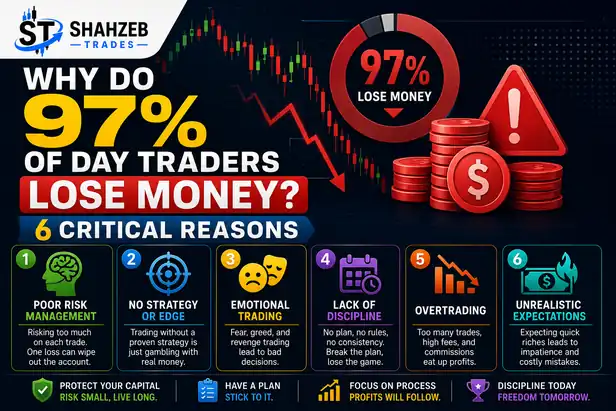
Why do 97% of day traders lose money? 6 Critical Reasons
Last Updated: September 2026
Introduction
Why do 97% of day traders lose money is one of the most searched and repeated questions in trading discussions, but the number needs context before it is used as a broad statement about every trader.
The often-cited 97% figure comes from research by Fernando Chague, Rodrigo De-Losso, and Bruno Giovannetti examining individual traders in the Brazilian equity-futures market. The researchers studied people who began day trading between 2013 and 2015 and focused on the 1,551 traders who persisted for more than 300 trading days. Among that persistent group, 97% lost money net of trading costs.
That finding is serious, but it does not mean that exactly 97% of all day traders everywhere lose money.
Other research points in a similar direction while using different samples and methods. A study published in the Review of Asset Pricing Studies found that only a small fraction of day traders were predictably profitable after costs, while the majority were associated with negative future performance.
So the more useful question is not simply why do 97% of day traders lose money.
It is:
What behaviors, costs, market conditions, and decision-making errors make consistent day trading so difficult?
This article breaks that problem down into six practical reasons.
What the 97% study actually found
Before examining the reasons, it is important to understand exactly what the research measured.
The Chague, De-Losso, and Giovannetti study used administrative trading records and examined individuals who traded Brazilian mini-Ibovespa futures. Their final persistent sample contained 1,551 people who day traded for more than 300 days. After exchange and brokerage fees, 97% lost money. The researchers reported an average daily net result of about −US$48.81 in the persistent group.
The paper also found that only a very small fraction earned amounts comparable with ordinary employment income, and the authors reported no evidence that simply continuing to day trade led to meaningful learning in that sample.
That last point is particularly important.
Many people assume:
More screen time → more experience → better results
The study did not find evidence supporting that simple progression for the traders it examined.
The research therefore gives us a useful starting point for understanding why do 97% of day traders lose money, but its geographic, market, and sample-specific limitations must remain clear.
1. Why do 97% of day traders lose money? They underestimate costs
Trading costs are easy to ignore because they rarely appear as dramatic losses on a chart.
Yet every trade can carry some combination of:
- Spread
- Commission
- Slippage
- Financing or overnight costs where applicable
- Exchange or platform-related costs
For a trader holding positions for weeks, these costs may be relatively small compared with the size of the move being targeted.
For a day trader taking many small positions, costs can become much more important.
Imagine a hypothetical strategy that produces an average gross edge of $6 per trade.
If the combined average trading cost is $4, the trader is left with only $2 before considering execution errors and unfavorable market conditions.
Now imagine the same trader doubles the number of trades without improving the quality of the setups.
The trader has not doubled the edge.
They may simply have doubled their exposure to transaction costs.
This is one reason the question why do 97% of day traders lose money cannot be answered only by discussing psychology. The economics of frequent trading matter too.
The original Brazilian research explicitly measured profitability net of exchange and brokerage fees, which is important because a strategy that appears profitable before costs can become unprofitable after costs.
A trader should therefore record gross and net performance separately.
For example:
| Metric | Example |
|---|---|
| Gross trading profit | $1,000 |
| Commissions | −$180 |
| Spread/slippage | −$120 |
| Net result | $700 |
The exact numbers vary by market and broker. The point is that net results are what matter.
2. Poor risk management creates large drawdowns
Another answer to why do 97% of day traders lose money is simple: some traders risk too much on individual positions.
A strategy does not need many consecutive losses to become dangerous when position size is excessive.
Consider a $10,000 account.
At 1% risk per trade, the planned loss is $100.
At 3%, it is $300.
At 5%, it is $500.
Now consider five consecutive full-stop losses:
| Risk per trade | Approx. balance after 5 losses |
|---|---|
| 1% | $9,510 |
| 2% | $9,039 |
| 3% | $8,587 |
| 5% | $7,738 |
These figures use fixed-percentage losses for illustration and exclude costs.
The difference is not merely cosmetic.
A trader who loses 5% repeatedly has to recover a much larger percentage of the remaining account.
This is why a sound risk management framework should define the maximum acceptable loss before a trade is opened.
The key sequence is:
Account size → risk percentage → dollar risk → stop distance → position size
Not:
Desired profit → huge position → hope the market moves
Risk management does not create a profitable strategy. It determines how much damage an unfavorable sequence can cause while you are testing one.
3. Overtrading turns small mistakes into large losses
A trader does not need to make one enormous mistake to destroy performance.
A series of small, unnecessary trades can do the job.
Overtrading often appears after:
- A missed setup
- A losing trade
- A large winning trade
- A period of boredom
- A desire to reach a daily profit target
- Fear of missing a market move
The trader starts seeing setups everywhere.
Suppose a strategy historically produces its best results from two or three high-quality setups per session.
The trader instead takes ten trades.
Even if each extra trade carries only small risk, the total exposure changes dramatically.
This helps answer why do 97% of day traders lose money from a practical perspective: traders often confuse activity with opportunity.
More trades are not automatically better.
In fact, if the additional entries are lower quality, increasing trade frequency can reduce the average quality of the entire sample.
A simple solution is to define a maximum number of trades or a clear setup filter.
For example:
No valid setup = no trade.
That rule sounds obvious, but it becomes difficult when the trader has a daily income target.
4. Psychology changes trading decisions
This may be the most difficult part of answering why do 97% of day traders lose money.
A trading plan can look perfect in a document.
Executing it while money is moving in real time is different.
A trader may:
- Move a stop-loss farther away
- Close a winning trade too early
- Increase position size after a loss
- Enter without confirmation
- Skip a valid setup after a recent loss
- Hold a losing trade because of hope
- Take revenge trades after a drawdown
These actions create a gap between the tested strategy and the actual strategy being traded.
Imagine your backtest says:
Risk = 1%
But after two losses, you decide to risk 3%.
Your live system is no longer the same system.
This matters because a trader can blame the strategy for a result caused partly by execution.
A useful trading psychology journal should therefore include more than profit and loss.
Record whether you:
Followed the entry rules
Followed the stop rule
Used the planned position size
Entered for the original reason
Changed the plan during the trade
That information can reveal whether the problem is market performance or execution discipline.
Research on experienced day traders also suggests that past experience alone does not guarantee profitable future performance. In the Review of Asset Pricing Studies, the consistently profitable and experienced subset represented less than 3% of all day traders in the study’s daily analysis, while most traders were associated with predictable losses after costs.
5. A strategy can look good without having an edge
Another reason behind why do 97% of day traders lose money is that many traders never establish whether their strategy actually has positive expectancy.
A strategy can look convincing on a chart and still fail statistically.
For example:
Strategy A
Win rate = 45%
Average win = $200
Average loss = $100
Expected result:
(0.45 × $200) − (0.55 × $100) = +$35
Now consider:
Strategy B
Win rate = 70%
Average win = $70
Average loss = $200
Expected result:
(0.70 × $70) − (0.30 × $200) = −$11
Strategy B wins far more frequently but still has negative expectancy in this simplified example.
This is why a trader should not evaluate a system using win rate alone.
Track:
- Win rate
- Average winner
- Average loser
- Expectancy
- Maximum drawdown
- Profit factor
- Number of trades
- Trading costs
- Performance by market condition
The question why do 97% of day traders lose money becomes easier to analyze when trading is treated as a measurable process rather than a collection of individual chart predictions.
For traders studying tools and data collection, trading tools can support the analysis, but the quality of the conclusions still depends on the quality of the underlying trade record.
6. Traders often chase income before proving consistency
A large income goal can distort risk decisions.
Suppose a trader has a $5,000 account and wants to make $1,000 every trading day.
That target represents 20% of the starting account in one day.
The mathematics alone should raise questions.
The trader may feel forced to:
- Use excessive leverage
- Increase trade size
- Trade more frequently
- Lower setup standards
- Hold positions longer than planned
- Increase risk after losses
The problem is not that having financial goals is inherently wrong.
The problem is allowing the financial goal to determine the trade.
This is another useful answer to why do 97% of day traders lose money: a trader can become focused on extracting a required amount of money from a market that has no obligation to provide a setup that day.
A better order is:
Strategy first
Risk second
Execution third
Financial outcome last
That order makes the process less dependent on whether today’s market happens to deliver the exact move you wanted.
How to avoid the same mistakes
The research should not be interpreted as “there is no point learning to trade.”
It should be interpreted as a warning about the difficulty of the activity.
A practical framework is:
Define one market and one setup
Avoid switching between dozens of strategies every week.
Write down precisely what qualifies as an entry.
Risk a predetermined amount
Choose the maximum amount you are willing to lose before entering.
Then calculate position size from the stop.
Track net performance
Include commissions, spread, and slippage wherever possible.
Limit unnecessary trades
If the setup is not there, there is nothing to execute.
Review execution separately from results
A losing trade can follow your rules.
A winning trade can violate them.
Those two situations should not be evaluated in the same way.
Use a meaningful sample
Do not decide that a strategy works or fails because of three trades.
Look at a sufficiently large sample and examine the distribution of results.
Separate trading money from essential money
Regulators have repeatedly warned that day trading carries substantial risk and should not be funded with money needed for essential living expenses.
The goal is to make the process more robust, not to increase risk until the income target is reached.
What the 97% figure does not prove
This point deserves its own section because online discussions often remove the context.
The 97% figure does not prove that exactly 97% of every day trader in every country loses money.
The original study was specific to:
- A Brazilian market
- Equity-futures trading
- Individual traders
- A defined period
- Traders who persisted beyond 300 trading days
The study is therefore important evidence, but not a universal census of global day traders.
Likewise, the study does not establish that every trader who loses money is simply lacking discipline.
Market structure, fees, competition, liquidity, leverage, strategy quality, and access to information all matter.
What the research does provide is a strong warning: persistent retail day trading has historically been very difficult to execute profitably after costs.
That conclusion is reinforced by other research showing that only a small subset of traders demonstrated predictable profitability after costs.
FAQ
Why do 97% of day traders lose money?
Why do 97% of day traders lose money is best answered by looking at several factors together: trading costs, excessive risk, overtrading, poor execution, weak strategy expectancy, and psychological mistakes. The 97% figure itself comes from a specific Brazilian equity-futures study of traders who persisted for more than 300 days, so it should not be treated as a universal statistic for all markets.
Is the 97% day trader loss statistic accurate?
Yes, the 97% figure is a real finding from the Chague, De-Losso, and Giovannetti study, but its scope is often exaggerated online. The researchers found that 97% of 1,551 persistent individual day traders in their Brazilian equity-futures sample lost money net of fees. It does not mean 97% of all day traders globally lose money.
Does having more trading experience make you profitable?
Not necessarily. In the Brazilian study, the researchers found no evidence that continued day trading produced meaningful learning within their sample. Other research has also found that only a relatively small subset of experienced, previously profitable traders showed predictable future profitability.
What is the biggest reason day traders lose money?
There is no single universal cause. Excessive trading costs, poor risk management, weak strategy expectancy, overtrading, and emotional decisions can interact. A trader who has a sound strategy but risks too much can still experience severe losses, while a disciplined trader using a strategy with negative expectancy can also lose over time.
Can a small account make day trading harder?
Yes. A small account limits the dollar amount that can be risked while keeping percentage risk controlled. Traders may respond by increasing leverage or position size to pursue larger dollar gains, which can create excessive account risk. The account size therefore affects the practicality of a trading plan even though capital alone does not create a trading edge.
Can a day trader become consistently profitable?
Some traders do achieve profitable results, but consistent profitability should not be assumed. The research shows that a relatively small proportion of retail day traders have historically demonstrated sustained profitability, and results vary significantly by market, strategy, costs, and trader behavior. A trader should build evidence from their own documented performance rather than assume success from a few winning sessions.
Risk Disclaimer
Day trading involves substantial financial risk, and losses can occur quickly. Research discussed in this article describes particular samples and markets and should not be interpreted as a forecast of any individual’s results. The information is educational and not personalized financial advice. Use only capital you can afford to lose and consider the specific costs, leverage, liquidity, and rules of your market and broker.
Conclusion
Why do 97% of day traders lose money is not a question with one simple answer.
The widely quoted 97% result comes from a specific Brazilian equity-futures study, not a universal survey of every day trader worldwide.
But the underlying lesson is still important.
Day trading creates a difficult combination of:
High decision frequency
Trading costs
Short-term uncertainty
Leverage
Psychological pressure
The need for a measurable edge
A trader can therefore lose money even while being active, knowledgeable, and highly motivated.
The strongest response is not to chase the small percentage that succeeds.
It is to understand the mechanisms that create poor outcomes and build a process designed to control them.
That means measuring net results, controlling position size, limiting unnecessary trades, testing expectancy, and separating financial goals from individual trade decisions.
So the real lesson behind why do 97% of day traders lose money is not that profitable trading is mathematically impossible.
It is that consistent retail day trading is difficult enough that risk management, evidence, and disciplined execution have to be treated as core parts of the strategy not optional extras.