
Last Updated: September 2026
Table of Contents
Introduction
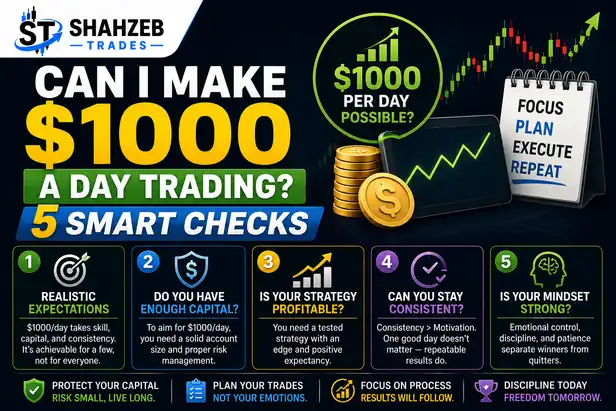
Can I make $1000 a day trading is a reasonable question, but the number alone does not tell you whether the target is realistic. A trader can have a profitable day and still have a losing month, while another trader may produce strong monthly results without making $1,000 on every session.
The biggest mistake is treating $1,000 per day as a trading requirement instead of a mathematical outcome that depends on capital, risk, strategy expectancy, trading frequency, and market conditions.
The U.S. Securities and Exchange Commission warns that day trading can be highly risky, particularly when traders use borrowed money or margin, and cautions investors against claims that emphasize easy or unusually large profits.
For retail forex, the risk is also significant. The CFTC currently says that roughly two out of three retail forex customers lose money after expenses are considered.
So can I make $1000 a day trading? Yes, a trader can have individual $1,000 days. But consistently producing that amount requires a very different capital and risk profile from simply having one successful session.
This article looks at five checks that can help you evaluate the target without relying on unrealistic assumptions.
1. Start with the math, not the target
Before asking can I make $1000 a day trading, calculate what percentage of your account $1,000 represents.
That one calculation immediately exposes whether your target is conservative, aggressive, or completely disconnected from the account size.
Consider these examples:
| Account Size | $1,000 Daily Result | Percentage |
|---|---|---|
| $2,000 | $1,000 | 50% |
| $5,000 | $1,000 | 20% |
| $10,000 | $1,000 | 10% |
| $25,000 | $1,000 | 4% |
| $50,000 | $1,000 | 2% |
| $100,000 | $1,000 | 1% |
These are mathematical illustrations, not return targets.
A trader with $2,000 would need a 50% daily gain to produce $1,000. Pursuing that kind of percentage every day would require extremely aggressive exposure and could create very large losses.
A trader with $100,000 needs a 1% daily result to produce the same $1,000.
That does not mean a 1% daily return is easy or dependable. It simply shows why capital matters.
So when someone asks can I make $1000 a day trading, the account balance needs to be part of the question.
The same dollar target can represent completely different levels of risk for different traders.
2. How much capital is needed for a $1000 trading day?
There is no universal account size that guarantees a particular daily result.
Anyone presenting one account balance as the exact amount required for $1,000 every day is oversimplifying the problem.
Instead, think in terms of required return.
If your account is $20,000, producing $1,000 in one session equals 5%.
At $50,000, it equals 2%.
At $100,000, it equals 1%.
At $250,000, it equals 0.4%.
The percentage gets smaller as capital gets larger.
This is an important reason that experienced traders often focus more on percentage risk and expectancy than on a fixed dollar amount.
Can I make $1000 a day trading is therefore not really a capital question by itself. It is a relationship between capital and the amount you expect the market to produce.
The larger the daily income target relative to your account, the more pressure you may feel to increase position size.
That can lead to:
- Oversized positions
- More trades than your strategy requires
- Lower-quality entries
- Wider losses
- Excessive leverage
- Emotional decisions after a losing trade
The SEC specifically warns that day trading can lead to substantial and immediate losses and says traders should be prepared for the possibility of losing the money committed to the activity.
That is why can I make $1000 a day trading should always be followed by another question:
“What percentage of my account am I willing to risk to pursue that result?”
3. Your strategy needs measurable expectancy
The next check is your strategy.
Can I make $1000 a day trading cannot be answered from a chart pattern, an indicator, or a few successful sessions.
You need evidence that your trading process has positive expectancy over a meaningful sample.
Expectancy can be simplified as:
Expected result = (Win rate × Average win) − (Loss rate × Average loss)
Imagine a hypothetical strategy:
- 45% win rate
- Average winning trade = $500
- 55% losing trade rate
- Average losing trade = $250
The simplified expectancy is:
(0.45 × $500) − (0.55 × $250)
= $225 − $137.50
= +$87.50 per trade
That does not mean the trader will make $87.50 on every trade.
Some trades will win, some will lose, and actual results can vary significantly.
But over a sufficiently large sample, positive expectancy gives you a mathematical framework for judging the process.
Now imagine another system:
- 70% wins
- Average win = $100
- 30% losses
- Average loss = $300
The expectancy becomes:
(0.70 × $100) − (0.30 × $300)
= $70 − $90
= −$20 per trade
The second system wins more often but has negative expectancy.
So can I make $1000 a day trading is not answered by asking how many winning trades you have.
You need to know the relationship between winners, losers, position size, and trading costs.
A useful trading tools workflow can help you record this information consistently, but the numbers need to come from your actual trades rather than assumptions.
4. Risk management determines whether the target is sensible
Even a strategy with positive expectancy can experience losing streaks.
That is why the answer to can I make $1000 a day trading depends heavily on how much you risk while pursuing the target.
Suppose a trader has a $50,000 account.
At 1% risk per trade:
Maximum planned loss = $500
At 2%:
Maximum planned loss = $1,000
This creates an important distinction.
A trader may want to make $1,000 in a session, but that does not mean risking $1,000 on the first trade.
One is a desired outcome.
The other is capital at risk.
They should not automatically be equal.
A professional risk framework starts with the amount you are willing to lose and then calculates position size from the stop-loss distance.
A simplified sequence is:
Account balance → risk percentage → dollar risk → stop-loss distance → position size
For example:
- Account = $50,000
- Risk = 1%
- Dollar risk = $500
- Stop distance = 25 pips
The appropriate position size depends on the currency pair and its pip value.
The stop should represent the level where the trade idea is invalidated rather than being moved simply to accommodate the desired dollar target.
A risk management plan should also define a maximum daily loss.
Suppose the daily limit is 2%.
On a $50,000 account:
Daily loss limit = $1,000
That means the trader could reach the daily loss limit before reaching the desired $1,000 profit.
This is not a contradiction.
It is a reminder that trading outcomes are uncertain.
The CFTC warns that leveraged forex trading can magnify both gains and losses, while its current consumer guidance says most retail forex customers lose money after costs.
5. Consistency matters more than one large day
A trader who makes $1,000 once has demonstrated that a $1,000 day is possible for that particular account and market environment.
It does not demonstrate that the trader can repeat it.
This distinction is central to can I make $1000 a day trading.
Imagine these five sessions:
| Day | Result |
|---|---|
| Monday | +$1,200 |
| Tuesday | −$600 |
| Wednesday | −$400 |
| Thursday | +$900 |
| Friday | −$300 |
| Week | +$800 |
The trader had two days above the $1,000 goal area, but the weekly result was only $800.
Now imagine another week:
| Day | Result |
|---|---|
| Monday | +$250 |
| Tuesday | +$300 |
| Wednesday | +$200 |
| Thursday | +$350 |
| Friday | +$250 |
| Week | +$1,350 |
The second trader never reached $1,000 in one day, yet produced a larger weekly result.
That is why fixed daily targets can distort decision-making.
There may be days with no valid setup.
There may be sessions with unusually strong movement.
There may also be periods where the market does not behave well for your particular strategy.
The trader’s job is not to manufacture a trade simply because the calendar says it is another trading day.
So can I make $1000 a day trading is better reframed as:
“Can my strategy produce a positive result over time while keeping risk controlled?”
That is the question worth measuring.
What $1000 a day really means
Suppose someone wants $1,000 per trading day across roughly 20 sessions in a month.
The simple mathematical target would be:
$1,000 × 20 = $20,000 per month
Again, that is not a realistic promise or expected outcome. It simply illustrates the scale of the target.
Before costs and taxes where applicable, $20,000 monthly corresponds to $240,000 over 12 months if the result were somehow achieved every month.
The problem is that actual trading does not distribute returns evenly.
You may have:
- several profitable days
- several losing days
- periods with no valid setup
- drawdown periods
- unusually volatile sessions
- quiet markets
This is why a trader should avoid building personal finances around an assumed fixed daily trading income.
The SEC’s investor guidance specifically warns against claims that emphasize easy profits and notes that day trading can generate large and immediate losses.
For someone asking can I make $1000 a day trading, the practical conclusion is that $1,000 should be considered a possible result on some days, not an obligation that the market must deliver every day.
Forex and the $1000 daily target
Forex is one of the markets where traders commonly ask can I make $1000 a day trading because leverage and position sizing can make large notional exposure available with relatively small margin.
That accessibility can be misleading.
The CFTC explains that most retail forex customers lose money after fees and related expenses, and it warns that leverage magnifies both gains and losses.
Suppose a trader has a $10,000 forex account and wants to make $1,000.
That requires a 10% gain in the account.
Trying to force that result every day can encourage the trader to use substantially more exposure than the strategy actually requires.
By contrast, the same $1,000 represents:
- 5% of a $20,000 account
- 2% of a $50,000 account
- 1% of a $100,000 account
Again, none of these percentages is a recommended daily return.
The comparison simply demonstrates why account size and desired income should be considered together.
The CFTC also recommends that traders understand the dealer, fees, spreads, margin requirements, and the risks associated with leveraged OTC forex.
For a trader using gold or other volatile instruments, the same principle applies: position size should come from the predefined risk and stop-loss, not from the amount of profit you want to see on the screen.
A practical framework before increasing size
If you are still asking can I make $1000 a day trading, use a process like this before increasing position size.
Step 1: Define your setup
Write down exactly what qualifies as a trade.
Include the market, timeframe, entry conditions, invalidation point, and exit rules.
Step 2: Measure the strategy
Review enough historical and live trades to estimate win rate, average win, average loss, drawdown, and expectancy.
Do not rely on a handful of trades.
Step 3: Set percentage risk
Decide your maximum account risk before the trade.
A fixed percentage can help prevent one losing sequence from becoming disproportionately damaging.
Step 4: Calculate the position
Use the stop-loss distance and instrument value to calculate the position size.
Do not choose position size first and then make the stop fit it.
Step 5: Set a daily stop
If your predefined loss limit is reached, stop trading.
A losing session does not need to become a larger losing session.
Step 6: Track performance over time
Review weekly and monthly results rather than judging yourself by one session.
Your trading psychology matters here because an aggressive daily target can create pressure to trade when no setup exists.
When $1000 a day becomes a dangerous target
The target itself is not automatically the problem.
The problem starts when the target changes your behavior.
For example:
Normal day: No valid setup → no trade.
Target-driven day: No valid setup → force a trade because the trader “needs” $1,000.
That small change can completely alter the risk profile.
Another example:
Normal loss: −$300 → stop according to plan.
Target-driven reaction: −$300 → increase size to recover $1,300.
This is where a trading target can become counterproductive.
The SEC warns that day trading requires substantial knowledge and can create large immediate losses, while its regulatory materials caution traders with limited resources against treating day trading as an easy path to large profits.
Therefore, can I make $1000 a day trading should never become “How do I force $1,000 today?”
Those are two completely different questions.
What should you measure instead?
A stronger performance dashboard focuses on process metrics.
Track:
Average daily result
Average win
Average loss
Maximum drawdown
Profit factor
Risk per trade
Rule-following percentage
Number of trades
Trading costs
Results by market condition
This provides much more information than simply counting days where you made $1,000.
For example, perhaps your average profitable day is $450 but your average losing day is $300.
That may tell you much more about the health of your trading process than whether you occasionally hit $1,000.
The CFTC’s guidance on retail forex also reinforces the importance of understanding costs and leverage rather than focusing only on potential gains.
FAQ
Can I make $1000 a day trading with a $10,000 account?
It is mathematically possible to make $1,000 on a $10,000 account during a particular session, but that represents a 10% daily gain. Treating 10% as a regular daily requirement would involve very aggressive expectations and could encourage excessive exposure. A trading strategy should be evaluated on overall expectancy and drawdown rather than a fixed daily dollar target.
How much capital do I need to make $1000 a day trading?
There is no universal capital requirement. The required account size depends on your strategy, risk model, trading costs, market, and the percentage return needed to produce $1,000. For example, $1,000 represents 1% of $100,000 but 10% of $10,000. Those are very different risk environments.
Can I make $1000 a day trading forex?
A trader can have individual $1,000 forex days, but consistent daily results should not be assumed. The CFTC reports that roughly two out of three retail forex customers lose money after costs, and it warns that leverage magnifies both gains and losses.
Is $1000 a day a good trading target?
A fixed daily dollar target can be counterproductive if it encourages you to trade when there is no valid setup. A better approach is to define risk, follow a tested process, and evaluate performance over a meaningful sample of trades. Some trading days may produce gains, while others may produce losses or no trade at all.
What risk percentage should I use to target $1000 a day?
The target should not determine the risk percentage. Risk should be established from your account size, strategy, stop-loss structure, and tolerance for drawdown. A trader might use a small percentage per trade and accept that daily results will vary rather than increasing exposure whenever the account is behind the desired target.
Can I make $1000 a day trading consistently?
Consistency is much harder than achieving an occasional $1,000 day. Markets change, setups vary, and losing periods occur. A stronger measure of consistency is positive expectancy combined with controlled drawdown over a large sample, rather than requiring the same dollar profit from every trading session.
Risk Disclaimer
Trading involves substantial financial risk, and losses can occur quickly. A trader may experience profitable and losing periods, and no strategy can guarantee a particular daily result. The examples in this article are educational only and are not personalized financial advice. Do not use money needed for essential expenses, and understand the costs, leverage, margin rules, and risks of the market and broker you use.
Conclusion
Can I make $1000 a day trading? Yes, individual days producing $1,000 are possible, but the more important question is whether your account size, strategy, and risk model can support that level of profit without forcing excessive exposure.
The math is straightforward.
The smaller the account, the larger the percentage return required to produce $1,000.
That does not make a larger account automatically profitable. It simply reduces the percentage return required for the same dollar amount.
A sensible trading process starts with risk rather than the daily income target:
Define the setup.
Measure the strategy.
Set risk before entry.
Calculate position size from the stop.
Accept that some days will produce losses or no trade.
Evaluate performance over time.
So can I make $1000 a day trading? It is possible as an occasional result and potentially achievable over longer periods for some traders, but there is no sound basis for treating $1,000 as a guaranteed or mandatory daily outcome.
The goal should not be to force the market to produce a number.
The goal should be to build a trading process where risk is controlled, decisions are repeatable, and results can be measured honestly.