
Table of Contents
What Is Spread in Forex?
What Is Spread in Forex is one of the first questions a new trader should understand because the spread directly affects the price at which a trade can be opened and closed.
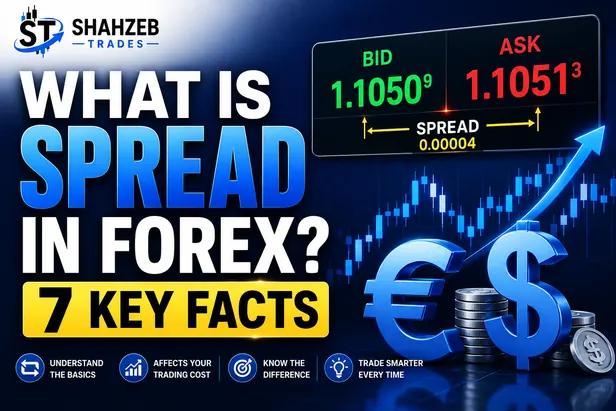
In simple terms, the spread is the difference between the bid price and the ask price of a currency pair. The bid is the price at which you can sell, while the ask is the price at which you can buy. The difference between those two prices is commonly called the bid-ask spread.
It may look like a tiny number on your trading platform, but small differences can matter, especially when you trade frequently or use short-term entries.
This guide explains the mechanics behind the spread, shows how to calculate it with a simple example, explains why it changes, and shows how traders can judge whether a spread is reasonable for the setup they are considering.
What Is Spread in Forex and Why Does It Matter?
What Is Spread in Forex becomes much easier to understand once you stop looking at it as a mysterious broker number and instead see it as part of the trading cost.
Imagine EUR/USD is quoted like this:
- Bid: 1.1000
- Ask: 1.1002
The difference is:
1.1002 − 1.1000 = 0.0002
For a typical EUR/USD quote, that equals 2 pips.
When you buy, you enter at the ask. When you sell, you enter at the bid. That difference means a position can begin with a small price disadvantage before the market has moved in your favor.
Investor.gov describes the bid-ask spread as an inherent trading cost and notes that a wider spread means a higher cost to buy and sell, excluding other commissions or transaction charges.
That is why spread matters even when a broker advertises a low or zero trading commission.
How the Bid and Ask Price Work
To understand What Is Spread in Forex, you need to be comfortable with two prices: bid and ask.
Bid Price
The bid is the price at which you can sell the currency pair.
If EUR/USD shows a bid of 1.1000, that is the price used when you sell at that quoted moment.
Ask Price
The ask is the price at which you can buy.
If the ask is 1.1002, your buy order is opened using that price.
The Difference Creates the Spread
The basic relationship is:
Spread = Ask Price − Bid Price
So if:
- Bid = 1.1000
- Ask = 1.1002
Then:
Spread = 0.0002 = 2 pips
CME Group also defines the bid-ask spread as the price difference between the bid and offer price.
The important point is that the bid and ask are not two unrelated numbers. They form a price range, and the distance between them is the spread.
How to Calculate the Forex Spread
The calculation is straightforward.
Formula:
Spread = Ask − Bid
For example, suppose GBP/USD is showing:
- Bid: 1.27540
- Ask: 1.27560
The difference is:
1.27560 − 1.27540 = 0.00020
On a standard five-decimal quote, that is typically 2 pips.
Another way to think about it is to convert the price difference into pips:
Price Difference ÷ Pip Size = Spread in Pips
For many major currency pairs, the standard pip size is 0.0001.
So:
0.00020 ÷ 0.0001 = 2 pips
Be careful with pairs such as USD/JPY because the conventional pip size is different. The cleanest approach is to check the quote format and contract specifications for the instrument you are trading.
A Simple Spread Example
Let us make the example more practical.
Suppose you are looking at EUR/USD and your platform shows:
Bid: 1.08500
Ask: 1.08520
Your spread is:
0.00020 = 2 pips
Now imagine you open a buy position.
You buy at 1.08520, while the current sell price is 1.08500.
That 2-pip gap is the spread.
If the market does not move, the position cannot simply be closed at the same price you entered because a buy position is closed using the bid price. This is why the spread can make a trade appear slightly negative immediately after entry.
The exact monetary effect depends on position size and the currency pair.
For a EUR/USD example, a standard lot of 100,000 units has a pip value of about $10 per pip, so a 2-pip spread would represent roughly $20 of spread cost at that position size. The actual amount can vary across instruments and account specifications.
This is one reason traders should understand What Is Spread in Forex before focusing only on entry signals.
What Is Spread in Forex Measured In?
What Is Spread in Forex is often answered using pips, although the platform may display the difference directly in price points.
For example:
- 1 pip on EUR/USD = 0.0001
- 2 pips = 0.0002
- 5 pips = 0.0005
Some trading platforms show fractional pips, sometimes called points or pipettes. A quote such as 1.10501 versus 1.10503 may represent a very small five-decimal price difference.
The key is not to confuse price precision with actual trading cost.
A smaller displayed number does not automatically mean your total transaction cost is lower. You also need to consider commissions and other charges.
Why Forex Spreads Change
Forex spreads are not always constant.
One of the biggest reasons is market liquidity. When there are many active buyers and sellers and strong market participation, spreads can often be tighter. During quieter conditions, major announcements, or periods of reduced liquidity, spreads can widen.
The timing of your trade can therefore matter.
Spreads may change around:
- Major economic announcements
- Market opens and closes
- Low-liquidity periods
- Sudden volatility
- Weekend reopen conditions
- Thin trading sessions
The CFTC notes that in OTC forex trading, dealers can set their own spreads, while your quoted prices come through the dealer rather than a centralized exchange.
This is important because two trading accounts may show different spreads on the same currency pair at the same moment.
If you trade around major economic events, checking the live spread before entering can be just as important as checking your technical setup.
Fixed vs Variable Forex Spreads
There are two common ways traders describe spreads: fixed and variable.
Fixed Spreads
A fixed spread is intended to stay at a defined level under stated trading conditions.
The advantage is predictability.
The limitation is that the quoted spread may not represent the full trading cost, and specific account conditions can still apply.
Variable Spreads
Variable spreads move with market conditions.
They can become very tight when liquidity is strong and wider when liquidity falls or volatility increases.
For active forex traders, variable spreads are common, so it is useful to understand the market environment rather than assuming the number will remain unchanged.
There is no single spread that is automatically suitable for every trader. Your strategy, instrument, trading session, account structure, and execution style all matter.
How Spread Affects Scalping and Day Trading
For short-term traders, What Is Spread in Forex is especially important.
A swing trader may hold a position through a much larger price movement, so a small spread may represent a relatively small part of the overall trade.
A scalper, however, may target only a few pips.
That changes the equation.
Suppose a trader targets 8 pips on a setup while the spread is 2 pips. The spread represents a meaningful portion of the expected price move.
Now imagine the same strategy is used with a 5-pip spread.
The trading cost takes up an even larger share of the target.
This does not mean every short-term trader needs the absolute lowest displayed spread. It means the spread should be considered alongside the strategy’s target, stop size, execution conditions, and total transaction costs.
Before building a short-term system, it is also worth reviewing broader risk management principles so trading costs are considered as part of the full plan rather than treated separately.
Spread vs Commission
Spread and commission are related to trading cost, but they are not the same thing.
Spread
The spread is the difference between bid and ask.
Commission
A commission is a separate charge that may be applied by the broker or trading venue.
Some account types advertise very tight spreads while charging a commission. Others may offer wider spreads without a separate commission line.
That is why looking only at the spread can give you an incomplete picture.
CME Group’s current discussion of FX trading costs separates transaction fees, bid-ask spread, and position holding costs as different components of the total cost of trading.
A practical comparison is therefore:
Total Trading Cost = Spread + Commission + Other Applicable Costs
This is much more useful than comparing account types based on one number alone.
How to Check a Forex Spread Before Trading
A simple pre-trade routine can help.
1. Check the Current Bid and Ask
Look at the live quote instead of relying on a marketing figure you saw earlier.
2. Calculate the Difference
Subtract the bid from the ask.
Ask − Bid = Spread
3. Convert It Into Pips
Make sure you understand the pip size for the currency pair.
4. Compare the Spread With Your Trade Plan
If your target is small, a relatively large spread deserves more attention.
5. Check the Session and Market Conditions
A spread that looks unusual may be connected to liquidity or volatility.
6. Consider the Full Cost
Check whether the account also charges a commission or another trading fee.
Your trading tools can help you organize this process, especially if you are comparing pairs, sessions, or different trading setups.
Common Mistakes Beginners Make
A common mistake is assuming that the displayed spread is the only thing that matters.
It is not.
Another mistake is comparing a broker’s advertised minimum spread with the spread actually shown during the trader’s normal session.
Conditions can change.
Beginners also sometimes use a very small profit target without considering how much of that target is consumed by spread and other costs.
A better approach is to ask:
How large is my expected price move, and how much of that move could be absorbed by trading costs?
That question is much more practical than simply asking whether a spread is “good” or “bad.”
Another useful habit is to compare the same currency pair during different market conditions. You may notice that the quote behaves differently during highly active periods compared with quieter periods.
FAQs
What Is Spread in Forex and how is it calculated?
What Is Spread in Forex refers to the difference between the bid and ask price of a currency pair. Calculate it by subtracting the bid from the ask. For example, an ask of 1.1002 and a bid of 1.1000 gives a spread of 0.0002, or 2 pips for a typical EUR/USD quote.
Why does the spread increase during volatile markets?
The spread can widen when market liquidity changes, price movement becomes unusually fast, or there is uncertainty around major economic events. Broker pricing and market conditions both influence the quoted bid and ask, so traders should check the live spread before entering a position.
Is a lower forex spread always better?
A lower spread can reduce one part of your trading cost, but it is not the only factor that matters. Traders should also consider commissions, execution conditions, holding costs, account structure, and the spread available during their normal trading hours.
How many pips is a normal forex spread?
There is no single normal spread for every currency pair or market condition. Major pairs can often show tighter spreads than less-liquid pairs, but the actual quote changes over time. Compare the live spread on the specific instrument and during the session when you normally trade.
Does spread matter more for scalpers?
Yes, spread can have a larger relative impact on scalpers because their expected price targets are often smaller. A few pips of trading cost can represent a meaningful portion of a short-term target, so spread should be included when evaluating the strategy’s expected trade size and cost structure.
Does every broker use the same forex spread?
No. OTC forex dealers can quote different bid and ask prices, and account structures can vary. The CFTC explains that OTC forex traders generally deal directly with a dealer rather than through a centralized exchange, so quoted conditions can differ between providers.
Risk Disclaimer
Trading forex involves substantial risk, and losses can occur quickly. Spreads, commissions, execution conditions, and market liquidity can change. The information in this article is for educational purposes only and is not personal financial advice. Past performance is not a reliable indicator of future results. Use appropriate risk management and trade only with money you can afford to lose.
Conclusion
Understanding What Is Spread in Forex gives traders a clearer view of what actually happens between the moment a trade is opened and the moment it is closed.
The core idea is simple:
Spread = Ask Price − Bid Price
But the practical impact depends on the instrument, position size, market conditions, trading session, and the rest of your transaction costs.
For beginners, the best habit is not to obsess over finding the smallest possible number. Instead, understand how the spread fits into your complete trading plan.
Check the live bid and ask, convert the difference into pips, compare it with your target and stop size, and remember that spread is only one part of the total cost of trading.
Once this becomes second nature, reading a forex quote becomes much easier — and you can evaluate your setups with a more realistic view of execution costs.