
Introduction
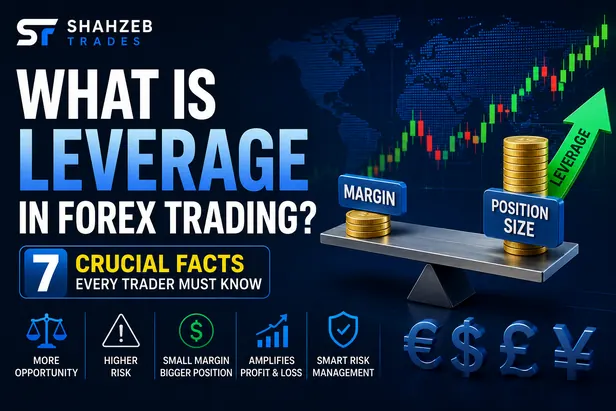
What Is Leverage in Forex Trading? It is one of the first questions many new traders ask after learning that a broker may allow them to control a position much larger than the cash deposited in their account.
Leverage can make it possible to access larger market exposure without providing the full notional value of the position upfront. However, leverage does not create money and does not make trading safer. It increases exposure, which means both potential gains and potential losses can become larger relative to the capital used.
For anyone learning what is leverage in Forex trading, the key idea is simple:
Leverage is a tool, not a strategy.
Table of Contents
What Is Leverage in Forex Trading?
What Is Leverage in Forex Trading? In simple terms, leverage allows a trader to control a larger market position with a smaller amount of capital used as margin.
For example, a 2% margin requirement could theoretically allow a trader to control a $100,000 position with $2,000 of margin, subject to the broker’s terms and the product being traded.
The important point is that the trader remains exposed to the price movement of the larger position.
If the market moves in the trader’s favor, the return relative to the capital used may be larger.
If the market moves against the trader, losses can also increase quickly.
That is why understanding what is leverage in Forex trading should always be connected to position sizing and risk management.
The CFTC advises retail Forex traders to research dealers, understand account disclosures, and recognize that leverage can amplify both gains and losses. Traders can review the official CFTC Forex customer advisory for additional educational information.
How Does Forex Leverage Work?
Leverage is generally expressed as a ratio.
Examples can include:
- 1:10
- 1:20
- 1:50
- 1:100
- 1:200
- 1:500
The exact leverage available depends on the broker, product, account type, jurisdiction, and regulatory requirements.
For example, with 1:100 leverage, a trader may theoretically control $100 of market exposure for every $1 of margin, subject to the applicable terms.
However, access to high leverage does not mean that a trader should use all of it.
A trader can have access to high leverage while still maintaining a relatively small position.
This distinction is important:
Available leverage and actual trading risk are not the same thing.
Your account may allow high leverage, but your position size, stop-loss, total exposure, and risk per trade determine how much risk you are actually taking.
What Is the Difference Between Leverage and Margin?
Leverage and margin are closely related, but they describe different things.
Leverage describes the relationship between your capital and the larger market exposure you can control.
Margin is the amount of capital required to open and maintain a leveraged position.
Think of it this way:
Leverage = market exposure relative to capital
Margin = capital required to support the position
For example, a 1% margin requirement corresponds to a theoretical 1:100 leverage relationship.
Actual margin requirements can vary by broker, product, jurisdiction, account type, and market conditions.
For retail OTC Forex traders, leverage can significantly increase the financial impact of adverse price movements, which is why understanding margin requirements is an important part of risk management.
What Is Leverage in Forex Trading With a Simple Example?
Consider a simplified example.
Suppose you have:
Account balance: $1,000
You open a position with a market value of:
$50,000
Your theoretical exposure relative to the account balance is:
50:1
This does not mean that you automatically risk the full $50,000.
Your actual trade risk depends on factors such as:
- Position size
- Stop-loss distance
- Pip value
- Spread
- Commissions
- Slippage
- Market movement
For example, if your trading plan defines a potential loss of $10 when the stop-loss is triggered, the planned trade risk is based on that amount rather than simply on the headline leverage ratio.
This is one of the most important lessons when learning what is leverage in Forex trading:
Leverage determines how much exposure you can control; position sizing determines how much exposure you actually take.
How Leverage Affects Profit and Loss
Leverage can make the effect of market movements on your capital more significant.
Imagine two traders are analyzing the same EUR/USD setup.
Trader A uses a small position.
Trader B uses a much larger position because greater exposure is available.
If EUR/USD moves 20 pips in the expected direction, Trader B may see a larger dollar result.
If EUR/USD moves 20 pips against the position, Trader B can also experience a larger dollar loss.
The market did not become more predictable.
The position simply became larger.
This is why what is leverage in Forex trading should never be explained only in terms of potential returns. The risk side is equally important.
Leveraged OTC Forex trading can produce losses that are substantial relative to the capital used, depending on the product, broker terms, account protections, and applicable rules.
What Is Leverage in Forex Trading for Beginners?
For beginners, what is leverage in Forex trading should primarily be viewed as a risk-management concept.
A new trader may see a leverage ratio such as 1:500 and assume that higher leverage automatically means more opportunity.
More available leverage can instead make it easier to open a position that is too large relative to the account.
A more structured process is:
- Decide how much you are willing to risk.
- Define the trade invalidation point.
- Determine the stop-loss.
- Calculate the appropriate position size.
- Check the margin requirement.
- Confirm that the resulting exposure fits your trading plan.
This keeps leverage in its proper role.
It should support the trading structure rather than determine it.
How Much Forex Leverage Should You Use?
There is no universal leverage ratio that is appropriate for every trader.
The amount of effective exposure that makes sense can depend on:
- Account size
- Strategy
- Position size
- Stop-loss distance
- Trading frequency
- Instrument volatility
- Risk tolerance
- Broker conditions
- Regulatory requirements
A trader who follows disciplined position sizing may not need to use all the leverage available in the account.
In some situations, lower effective exposure may also make it easier to manage the psychological impact of normal price fluctuations.
When learning what is leverage in Forex trading, focus less on the largest number your broker advertises and more on your actual exposure.
The Risks of High Forex Leverage
High leverage can create several risks.
Larger Losses
A larger position means the same market movement can have a larger monetary impact.
Margin Pressure
A position that moves sharply against you can consume available margin and may require action depending on the broker’s rules.
Emotional Trading
When a position is too large, ordinary market fluctuations can feel much more significant.
This may encourage:
- Closing trades too early
- Moving stop-losses
- Revenge trading
- Adding to losing positions
- Increasing risk after a loss
Overtrading
High available leverage can make it tempting to open multiple positions simply because the account permits more exposure.
The amount a trader can technically control is not necessarily the amount they should trade.
How Leverage and Stop-Loss Work Together
Leverage and stop-loss management should be considered together.
Suppose you have a:
$2,000 account
and decide that your maximum planned risk on one trade is:
1%
That means:
Maximum planned risk = $20
Now suppose your technical setup requires a relatively wide stop-loss.
Instead of increasing position size simply to maintain a preferred lot amount, you can calculate a smaller position so that the planned loss remains close to your $20 risk limit, subject to spread, commission, slippage, and execution conditions.
This is where leverage becomes secondary.
Your analysis determines where the stop-loss should be.
Your risk plan determines how much you should trade.
Your available leverage provides access to the required exposure.
For more detail on position sizing, read our How to Calculate Forex Lot Size guide.
What Is Leverage in Forex Trading and Position Size?
The relationship becomes clearer when comparing traders with identical account sizes.
Suppose two traders each have:
$1,000
Trader A opens a relatively small position.
Trader B uses more of the available exposure and opens a much larger position.
Even though both accounts are the same size, their actual market exposure is very different.
Therefore, risk is not determined only by the leverage ratio shown by the broker.
It also depends on the position itself.
This is why what is leverage in Forex trading should be understood alongside lot size, margin, stop-loss distance, and overall exposure.
You can also review our What Is Risk Management in Trading? guide for a broader explanation of position sizing and risk limits.
How to Manage Leverage Responsibly
There is no completely risk-free way to trade leveraged financial products.
However, a disciplined process can help control exposure.
Set a Maximum Risk Per Trade
Choose a predefined risk limit that fits your account and circumstances.
Calculate Position Size Before Entering
Do not choose a lot size simply because you want to make a certain amount of money.
Use a Logical Stop-Loss
Place the stop where the trade idea becomes invalid rather than moving it purely to support a larger position.
Avoid Maximum Exposure
You do not need to use all available leverage simply because your broker offers it.
Monitor Total Exposure
Several simultaneous positions can create substantially more effective risk than any single trade suggests.
Set a Daily Loss Limit
A daily limit can help reduce the chance of emotionally increasing risk after a losing streak.
Review Your Broker Carefully
For OTC Forex, the broker or dealer can be your direct counterparty depending on the arrangement.
Before opening an account, review the provider’s regulatory status, risk disclosures, fees, execution conditions, and relevant account terms.
The CFTC Forex customer advisory provides educational information for retail Forex customers.
Traders should also be alert to warning signs such as unregistered providers, unrealistic return promises, and requests for additional money. The CFTC Forex fraud awareness resource provides additional information.
Common Forex Leverage Mistakes
Using the Highest Leverage Available
Maximum available leverage does not mean maximum appropriate exposure.
Confusing Leverage With Risk
You can have high available leverage and still take a relatively small position.
You can also have lower available leverage and still take too much risk relative to your account.
Ignoring Margin
A trader can focus entirely on price action and overlook how open positions affect available margin.
Increasing Position Size After a Loss
Trying to recover a previous loss by increasing position size can quickly create a much larger drawdown.
Trading Without a Stop-Loss Plan
Leverage makes uncontrolled exposure more dangerous because oversized positions can generate losses quickly.
Treating Leverage as a Profit Strategy
Leverage changes exposure.
It does not tell you where the market will move.
Frequently Asked Questions
What is leverage in Forex trading?
Leverage is a mechanism that allows a trader to control a larger market position with a smaller amount of capital used as margin. It can increase the effect of market movements on both potential gains and potential losses.
Is high leverage good for beginners?
High leverage is not automatically better for beginners. It can make oversized positions easier to open, so new traders should focus on position sizing, margin, and risk management rather than simply selecting the highest available ratio.
Does leverage increase profit?
Leverage can increase the effect of price movements on the capital used in a trade because it allows greater market exposure. The same mechanism can also increase losses.
What is the difference between leverage and margin?
Leverage describes the relationship between trading capital and market exposure, while margin is the capital required to open and maintain a leveraged position.
Can you lose more than your deposit with Forex leverage?
Depending on the product, jurisdiction, broker terms, and account protections, losses may potentially exceed the initial deposit. Traders should review the specific risk disclosures that apply to their account and jurisdiction.
What leverage is safest in Forex?
There is no single leverage ratio that is safest for every trader.
Effective risk depends on position size, stop-loss distance, account size, total exposure, margin requirements, and risk tolerance.
Should beginners use leverage?
Beginners should first understand margin, position sizing, stop-loss management, and the risks of leveraged products before using meaningful capital.
Final Thoughts
So, what is leverage in Forex trading?
It is a tool that allows traders to control a larger market position with less capital used as margin.
That can provide greater market exposure, but it can also magnify losses.
Instead of asking:
“How much leverage can my broker give me?”
ask:
“How much exposure actually makes sense for my account and strategy?”
Start with risk.
Define your stop-loss.
Calculate your position size.
Then check whether the required exposure and margin fit your account.
Leverage should be something you manage, not something you chase.
For more practical Forex education, explore Shahzeb Trades and our trading resources.
Risk Disclaimer
This article is provided for educational and informational purposes only and should not be considered financial or investment advice.
Forex and other leveraged financial products involve significant risk of loss. Leverage can magnify both gains and losses, and actual outcomes can vary depending on the instrument, broker, account type, market conditions, margin requirements, execution, and applicable regulations.
Losses may potentially exceed the initial amount deposited in some leveraged Forex arrangements. Always review the relevant product disclosures and broker terms before trading, understand your maximum potential exposure, consider your financial situation and risk tolerance, and never trade with money you cannot afford to lose.