
Last Updated Date
September 2026
Table of Contents
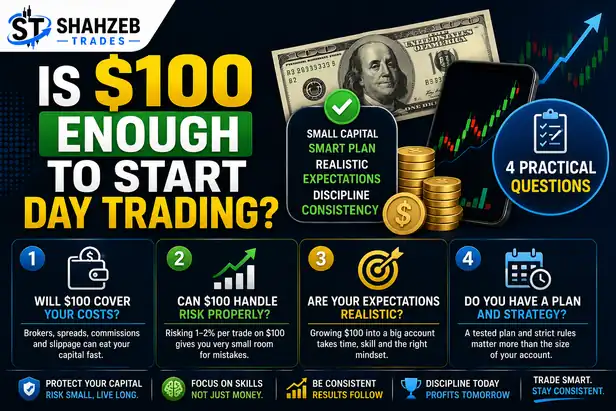
Is $100 Enough to Start Day Trading? 4 Practical Questions
Is $100 Enough to Start Day Trading depends on what you mean by “start.”
If your goal is to open a small account, place very small trades, and learn how real-money execution feels, $100 can be enough with some brokers and markets. If your goal is to generate meaningful or dependable income from day trading, $100 is a very different proposition.
That distinction matters because account size changes what is mathematically practical. With a $100 account, even a 1% risk limit equals only $1 per trade. Small spreads, commissions, slippage, and a few consecutive losses can therefore have a noticeable effect on the account.
Current U.S. rules also need to be separated from the general question. FINRA replaced the former pattern-day-trader margin provisions with new intraday margin requirements effective June 4, 2026, while allowing a transition period through October 20, 2027 for firms that need more time to comply. Your broker may therefore have different implementation timing or house requirements. (FINRA)
For forex, the question is different again because retail OTC forex has its own leverage, margin, and dealer structure. The CFTC warns that leveraged forex can create substantial losses and advises traders to research the dealer and understand the risks before depositing funds. (CFTC forex advisory)
So the useful way to answer Is $100 Enough to Start Day Trading is to separate access, risk, and expectations.
Is $100 Enough to Start Day Trading? The Real Answer
A $100 account can be large enough to begin learning in some environments, but it is too small to give you much room for error.
That does not automatically make a $100 account useless.
It changes its purpose.
A small account can be viewed as a training account. The objective is to learn execution, discipline, position sizing, and emotional control while keeping the dollar amount limited.
It should not be treated as a realistic substitute for the capital required to generate a meaningful income stream.
Investor.gov describes day trading as extremely risky and notes that it can produce substantial financial losses in a short period. It also warns that leverage can magnify losses. (Investor.gov)
That is why Is $100 Enough to Start Day Trading has two different answers:
For learning: potentially yes.
For dependable income: generally no.
The exact answer still depends on the market, broker, fees, position-size rules, and whether you are trading stocks, forex, or another instrument.
What Can a $100 Account Actually Do?
A $100 account can teach you something a demo account cannot fully reproduce: how you behave when a small amount of real money is moving.
You can experience:
- Real order execution
- Real spreads or commissions
- Slippage
- The psychological effect of a losing trade
- The temptation to overtrade
- The pressure of waiting for a setup
But there is a major limitation.
The account has very little financial buffer.
If you lose $10, you have already lost 10% of the account.
A second $10 loss brings the account down another 11.1% from the remaining balance if measured sequentially.
This means aggressive recovery attempts become especially dangerous.
A $100 account therefore needs a very different mindset from the social-media idea of turning a tiny balance into thousands quickly.
That kind of growth target would require taking very large risks relative to the starting balance, which can make account survival difficult.
4 Practical Questions About Is $100 Enough to Start Day Trading
1. Can You Actually Open and Trade With $100?
In some markets and account structures, yes.
But “can I open an account?” and “can I trade sensibly with that amount?” are different questions.
Some brokers allow very small account sizes and small position sizes. Others have higher minimums or account conditions.
For U.S. securities, the former $25,000 pattern-day-trader requirement has been replaced by new intraday margin requirements beginning June 4, 2026, with a transition period for some firms. That means older articles repeating the $25,000 rule without mentioning the 2026 change may now be outdated. Investors should check the specific broker’s current requirements rather than relying on an old article. (FINRA)
For OTC forex, account access can vary by dealer and jurisdiction. The CFTC warns that leverage can amplify both gains and losses and advises traders to research dealers carefully. (CFTC)
So before funding a $100 account, check:
- Minimum deposit
- Minimum position size
- Margin requirements
- Trading costs
- Withdrawal rules
- Regulatory status where applicable
- Whether the account is cash or margin
The answer to Is $100 Enough to Start Day Trading therefore depends partly on the actual trading environment.
2. Can $100 Produce Meaningful Trading Income?
This is where expectations often become unrealistic.
Suppose you make 1% on a $100 account.
That is $1.
Even a 5% monthly return would equal only $5 before any trading costs and taxes that may apply.
This does not mean percentage returns are irrelevant. It means the starting capital matters enormously when your objective is income.
Trying to force a larger dollar result from a tiny account usually means increasing position size or taking more risk.
That changes the question from:
“How much can I reasonably earn?”
to:
“How much am I willing to risk to try to earn more?”
That is the wrong direction for a beginner.
Investor.gov warns that day trading can cause substantial losses in a very short period and says people should understand their risk tolerance and financial circumstances before participating. (Investor.gov)
So if someone asks, Is $100 Enough to Start Day Trading, a realistic answer should not promise that $100 can become a reliable income source.
3. How Much Should a $100 Trader Risk?
There is no universal percentage that is suitable for every person or every strategy.
But the mathematics are easy to see.
At 1% risk:
$100 × 1% = $1
At 2% risk:
$100 × 2% = $2
At 5% risk:
$100 × 5% = $5
The higher the percentage, the faster a losing streak can reduce the account.
Consider five consecutive losses:
At 1% initial risk with fixed dollar risk of $1 per trade, the account would fall to about $95 after five losses.
At $5 risk per trade, the account would fall to $75 after those five losses if the dollar risk remained fixed.
The problem gets worse when traders increase risk after each loss.
That can turn a manageable losing period into a major drawdown.
Your risk management plan should therefore come first.
With a small account, position size should be based on the amount you are prepared to lose and the distance to your stop, rather than on the maximum position your broker allows.
The CFTC’s forex guidance emphasizes the risks of leverage and margin, including the possibility of losses that can exceed the initial amount deposited in certain OTC forex arrangements. (CFTC)
4. When Should You Add More Capital?
Adding money should not be the solution to poor execution.
If you lose $100 because you ignored risk rules, adding another $500 does not fix the underlying problem.
A better reason to increase capital is that your process has already shown consistency.
For example, you might first demonstrate that you can:
- Follow your entry rules
- Respect your stop
- Keep position size consistent
- Avoid revenge trading
- Avoid unnecessary trades
- Maintain a journal
- Review results objectively
Then, after evaluating a meaningful sample, you can consider whether larger capital makes sense for your circumstances.
The key is to scale a process, not an emotional need for bigger profits.
This is one of the most important lessons behind Is $100 Enough to Start Day Trading.
Forex vs Stocks With a $100 Account
The answer to Is $100 Enough to Start Day Trading changes depending on the market.
Forex
Retail forex often allows smaller position sizes than many traditional stock setups, depending on the broker and account structure.
That can make very small balances technically easier to deploy.
However, leverage is the major issue.
The CFTC warns that leveraged OTC forex trading can amplify losses and that customers may lose all of their margin and potentially more under certain circumstances. (CFTC)
So a low entry requirement does not mean low risk.
Stocks
Stock trading has a different structure.
The current U.S. regulatory environment around frequent margin day trading changed in 2026, so older content about the traditional PDT rule should not be treated as current without checking the broker and effective requirements. (FINRA)
A $100 stock account can also face practical limitations from share prices, fees, settlement rules, broker requirements, and position-size constraints.
For either market, $100 should be viewed as a small learning balance rather than a large capital base.
A Simple $100 Risk Example
Suppose a trader starts with $100.
The trader decides to risk a maximum of 1% per trade.
That is:
$100 × 1% = $1
Now suppose the planned stop represents 20 pips on a forex pair.
The trader needs to calculate the position size so that the planned loss at that stop is approximately $1, taking the broker’s pip value, account currency, spread, and trading conditions into account.
The trader should not say:
“I only have $100, so I will use the smallest lot available.”
The smallest available lot may still represent too much risk for a particular stop.
Position size should come from the risk calculation.
This example also shows why a $100 account is not a shortcut to substantial income.
If the trader follows the plan perfectly and the first trade makes 2R, the gain would be approximately $2 before costs in this simplified example.
That may look small.
It is supposed to.
The purpose is to keep the risk small enough that the trader can focus on execution.
The Biggest Problems With Day Trading a Tiny Account
Tiny Accounts Encourage Oversizing
A trader may dislike seeing $1 or $2 gains and decide that the position needs to be larger.
That can destroy the original risk framework.
Costs Matter More
When the account is small, even modest spreads, commissions, or other trading costs can take a larger percentage of the available capital.
Drawdowns Feel Larger
A $10 loss is only $10 in absolute terms, but it represents 10% of a $100 account.
Recovery then becomes mathematically harder.
Emotional Pressure Can Increase
The trader may start thinking:
“I need this trade to work.”
That expectation can lead to early exits, stop movement, or revenge trading.
Small Accounts Create Unrealistic Expectations
Social media often highlights extreme account-growth examples without presenting the full distribution of outcomes.
The CFTC specifically warns about claims of outsized returns and notes that many retail OTC forex customers lose money. (CFTC)
The important question is not how quickly an account can theoretically grow.
It is whether the risk required to pursue that growth is appropriate.
How to Use $100 as a Training Account
A small account can be useful when it has a clearly defined purpose.
Phase 1: Learn
Understand your market, broker, order types, spreads, position sizing, and platform.
Phase 2: Practice
Use a demo account first when possible.
Then use a very small live account only when you understand the mechanics and can accept the money being at risk.
Phase 3: Follow One Plan
Do not change strategies every few days.
Choose a clear setup and define when it is valid.
Phase 4: Track Every Trade
Use your trading tools to keep a journal containing:
- Entry
- Stop
- Target
- Position size
- Planned risk
- Result
- Setup type
- Rule followed?
- Emotional state
Phase 5: Review Before Scaling
Look for consistent execution rather than one unusually profitable trade.
Your results should tell you whether you are following the process.
That is a much better answer to Is $100 Enough to Start Day Trading than simply saying yes or no.
FAQs
Is $100 Enough to Start Day Trading for a Beginner?
Is $100 Enough to Start Day Trading for learning purposes? In some markets and account structures, yes. A $100 balance can provide limited real-money practice, but it offers very little room for mistakes. It should not be treated as a dependable income account, and the broker’s minimums, costs, and position-size rules must be checked first.
Can I make $10 a day from a $100 trading account?
A $10 daily target would equal 10% of a $100 account each day. Pursuing that target consistently would require unusually high risk relative to the account size and is not a realistic baseline for a beginner. A small account is better treated as a learning environment than a fixed-income source.
Is forex or stocks better for day trading with $100?
Neither is universally better. Forex may allow smaller position sizes at some brokers, but leverage can significantly increase risk. Stocks have different account, settlement, and margin considerations. The right choice depends on the instrument, broker, costs, and the trader’s risk capacity.
Should I use leverage with a $100 account?
Leverage should not be treated as a reason to increase risk. In leveraged markets, a small account can control a larger position, which can also magnify losses. The CFTC warns that leveraged OTC forex can lead to substantial losses and advises traders to understand margin and dealer risks before trading.
How much should I risk per trade with $100?
There is no universal figure that fits every trader. A smaller predefined risk percentage generally gives a small account more room to withstand a sequence of losses. Whatever rule you choose, calculate position size from the actual stop distance and instrument value rather than simply selecting a lot size first.
When should I increase my trading capital?
Consider increasing capital only after you have evidence that you can consistently follow your strategy and risk rules. More money does not correct poor execution. Scaling should come after process quality has been demonstrated over a meaningful sample.
Risk Disclaimer
Day trading and leveraged financial markets involve substantial risk. A $100 account can be lost quickly, and a small balance does not eliminate market, execution, leverage, spread, or liquidity risk. This article is for educational purposes only and is not personal financial advice. Broker rules and regulations vary by market and jurisdiction. Understand the account terms, costs, margin requirements, and risks before trading, and use only capital you can afford to lose.
Conclusion
The answer to Is $100 Enough to Start Day Trading is yes for limited practice in some markets, but no as a realistic capital base for dependable trading income.
A $100 account can teach you valuable skills:
Risk control.
Position sizing.
Execution.
Patience.
Discipline.
What it cannot realistically provide is much room for mistakes or a sensible basis for aggressive income targets.
The best approach is to treat the balance as a small training environment.
Define your setup.
Define your risk.
Keep your position size controlled.
Track every trade.
Review your process.
Then decide whether additional capital is justified.
A small account is not automatically a problem. Using a small account to take large risks is the problem.
That is the key takeaway from Is $100 Enough to Start Day Trading: start with realistic expectations, protect the downside, and let your trading process earn the right to be scaled.