
How to Stop Overtrading starts with understanding one important distinction: taking many trades is not automatically the same as overtrading.
A trader can take several planned trades during an active session and remain within the strategy. Another trader can take only a few trades but still be overtrading if those entries were outside the plan.
The real issue is the gap between the trades you intended to take and the trades you actually took.
Recent trading-education discussions make the same point: overtrading is better viewed as a decision-quality problem than as a universal trade-count problem. The useful question is when additional trades stop meeting the same standards as the original setup.
That makes How to Stop Overtrading a process problem.
The solution is not simply telling yourself, “I will trade less tomorrow.”
Instead, define valid setups, identify the situations that trigger unnecessary entries, set measurable limits, and review your actual trading history.
What Is Overtrading?
Overtrading happens when trading activity goes beyond what your strategy, risk plan, or trading rules justify.
There is no universal number of trades that automatically means someone is overtrading.
For one short-term strategy, several entries may be part of the normal process. For another approach, one impulsive trade outside the plan may already be a problem.
Look for the behavior behind the trade.
An entry may be unnecessary when:
- There is no valid setup.
- You are trading because you are bored.
- You are trying to recover a recent loss.
- You are chasing a move after the planned entry has passed.
- You are increasing activity because you had an early winner.
- You are trading simply because you have been watching the chart for a long time.
IG’s educational guidance similarly identifies emotions such as fear, excitement, and greed as possible causes of overtrading and recommends using clearer trading rules and risk management to reduce emotionally driven decisions.
This is why How to Stop Overtrading should begin with your decision process, not an arbitrary number.
Why Traders Overtrade
Overtrading usually has a trigger.
The trigger can be emotional, environmental, or structural.
Boredom
The market is quiet. No clean setup appears. You continue watching.
Eventually, a small movement looks interesting enough to justify an entry.
The trade was created because the trader wanted activity, not because the setup met the plan.
FOMO
Price starts moving quickly and you feel late.
Instead of waiting for the next valid setup, you enter because you are afraid the opportunity is disappearing.
Revenge
A losing trade creates an urge to recover the loss immediately.
The next position becomes emotionally connected to the previous one.
Overconfidence
A strong start can produce the feeling that conditions are easy.
The trader begins accepting weaker setups because recent trades were successful.
No Clear Trade Definition
This may be the biggest structural problem.
If your plan does not define what qualifies as a valid setup, almost any market movement can be interpreted as an opportunity.
The question How to Stop Overtrading becomes much easier once the boundary between “trade” and “not a trade” is written down.
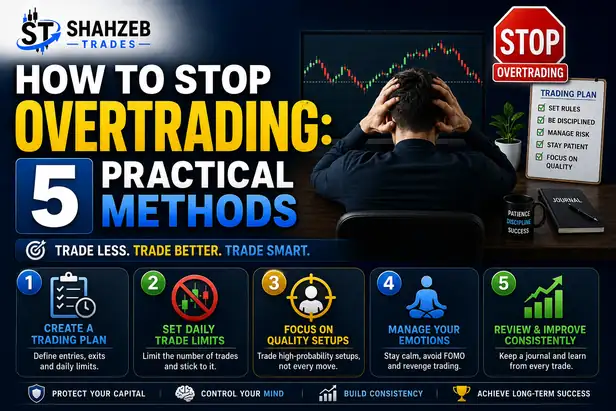
5 Practical Methods for How to Stop Overtrading
1. Define What Counts as a Valid Trade
The first method for How to Stop Overtrading is to create an entry gate.
Before the session starts, write the conditions that must exist before you can enter.
For example:
- Market context is suitable.
- The setup matches your strategy.
- The entry trigger is present.
- The invalidation level is clear.
- Position size follows your risk rule.
- The trade fits your planned session.
Now create the opposite rule:
If one required condition is missing, the trade is rejected.
This changes waiting from a passive activity into an active decision.
You are no longer asking, “Can I find a reason to enter?”
You are asking, “Has my setup actually appeared?”
That distinction is central to How to Stop Overtrading.
A written entry gate can also make your trading journal more useful because each trade can later be classified as either in-plan or outside-plan.
2. Set a Predefined Trade Limit
A trade limit can add friction to impulsive behavior.
The limit should come from your strategy and personal trading history rather than being copied from someone else.
For example, suppose your journal shows that your first three trades during a particular session are usually planned, while later entries often happen because of boredom.
You could test a rule that ends new entries after a predefined number of trades.
The number itself is not the important part.
The important part is that the limit exists before you feel the urge to continue.
You can also define a maximum daily loss alongside a trade-frequency rule.
That creates two separate boundaries:
Activity limit: how much you are allowed to trade.
Risk limit: how much you are allowed to lose.
CME Group’s trade-plan education emphasizes putting risk-management rules into the trading plan rather than relying on decisions made in the middle of a trade.
For How to Stop Overtrading, measurable limits are generally more useful than a vague goal to “be disciplined.”
3. Identify Your Overtrading Triggers
Do not assume boredom is your only trigger.
Track what happens immediately before the extra trade.
Ask:
What happened just before I clicked?
Maybe you had:
- A losing trade
- A winning trade
- A missed entry
- A long period without activity
- A fast candle
- A sudden market headline
- A change in floating P&L
Then ask:
What was I trying to achieve?
Was it:
- Recovering money?
- Avoiding regret?
- Feeling active?
- Catching a move?
- Increasing today’s profit?
- Proving that your analysis was correct?
This turns How to Stop Overtrading into a personal investigation.
A recent 2026 study guide on the topic recommends examining trade history to find the point where trade quality deteriorates and then building a guardrail around the specific trigger.
Your Trading Psychology resource can also fit naturally into this process because overtrading is often connected to behavioral patterns rather than chart analysis alone.
4. Use a Cooling-Off Rule After Losses
A losing trade can create urgency.
That urgency is exactly when another rule can help.
Create a cooling-off condition such as:
After a loss, I wait until the next fully valid setup before entering again.
Or:
After reaching my daily loss limit, I stop opening new positions.
The rule should be specific enough that there is little room to negotiate with yourself.
Without a predefined rule, the trader can say:
“Just one more trade.”
That phrase is often where the original plan starts to disappear.
The CFTC recommends developing a risk-management plan for forex trading and highlights the importance of understanding the risks associated with leveraged trading.
A practical risk management framework can therefore support How to Stop Overtrading by limiting the amount of risk available for impulsive decisions.
5. Review Your Trade History
This is where the process becomes measurable.
Do not review only your biggest winning and losing trades.
Group your trades by sequence.
For example:
Trade 1: planned
Trade 2: planned
Trade 3: planned
Trade 4: boredom
Trade 5: revenge
Trade 6: FOMO
Now you have something specific to investigate.
Ask:
- At which trade number does quality decline?
- Which trigger appears most often?
- Does overtrading happen more after wins or losses?
- Does it happen during particular sessions?
- Are the extra trades less aligned with your setup?
- Are you increasing size as well as trade frequency?
A 2026 trading-discipline guide recommends comparing early and later trades in a session and identifying the point where setup quality, sizing, or rule adherence begins to deteriorate.
This is far more actionable than simply telling yourself to trade less.
A Practical Overtrading Example
Imagine a trader has a plan built around selective intraday setups.
During the first part of the session, two valid trades appear.
The first trade loses.
The second trade wins.
Then the market slows down.
No valid setup appears for the next hour.
The trader becomes bored.
A small breakout appears, but it does not meet the original entry conditions.
The trader enters anyway.
That trade loses.
A second weak setup appears.
The trader enters again because the first extra trade lost.
Now the problem is obvious.
The first two trades followed the plan.
The next two were created by emotional reactions.
The trader could improve How to Stop Overtrading by adding two rules:
Rule 1: No entry unless every setup condition is present.
Rule 2: After a losing off-plan trade, stop and review before opening another position.
Notice that the solution is not “take exactly two trades every day.”
The solution is to identify which trades were justified and which were not.
How to Stop Overtrading During Slow Markets
Slow markets can be surprisingly difficult because there is less information to react to.
That creates boredom.
And boredom creates a temptation to manufacture activity.
The answer is to define a “no-trade environment.”
For example:
If volatility, structure, or setup quality does not meet my plan, I stay flat.
This is an important mindset shift.
Being out of the market is not failing to trade.
It is a decision.
One recent guide on overtrading makes the same distinction: the goal is not simply fewer trades; it is avoiding additional trades that no longer meet the required standard.
For How to Stop Overtrading, this means learning to see inactivity as part of the strategy.
How to Stop Overtrading After a Winning Trade
Winning can create a different form of overtrading.
The trader makes a profitable trade early in the session.
Confidence increases.
The next setup looks only moderately attractive, but the trader thinks:
“I am already up today, so I can take it.”
That logic is dangerous because the size of the earlier win does not improve the quality of the new setup.
Treat the next trade independently.
Ask:
- Does it meet the same conditions?
- Is the risk still within the plan?
- Would I take it if the previous trade had lost?
- Am I entering because the setup exists or because today’s P&L looks good?
This is another useful application of How to Stop Overtrading: do not let a previous result change the standards for the next trade.
Build a Simple Anti-Overtrading Routine
Use this routine before each session.
Before Trading
Write:
Valid setup:
What conditions must exist?
Maximum planned activity:
How many trades can I take under my tested rules?
Maximum risk:
What is my daily risk limit?
Main trigger:
What behavior am I most likely to repeat today?
Before Every Entry
Ask:
1. Does the setup meet every required condition?
2. Is this trade part of the original plan?
3. Am I entering because of the market or because of my emotional state?
4. Would I still take this trade if the last trade had the opposite result?
If the answer to the third question points toward boredom, revenge, FOMO, or excitement, pause.
After the Session
Classify every trade:
A — Fully planned
B — Borderline
C — Outside the plan
Then review your C trades first.
Those trades usually tell you more about How to Stop Overtrading than your best setups do.
Your Trading Tools can help keep this checklist and journal process organized.
Common Overtrading Mistakes
Thinking More Trades Mean More Opportunity
More activity does not automatically create better setups.
Using a Fixed Trade Number Without Reviewing Your Strategy
A universal trade limit may be arbitrary. Your own data should help determine where a useful boundary belongs.
Treating Every Small Move as a Setup
Without defined entry conditions, every chart movement can start looking tradable.
Continuing After the Daily Risk Limit
Once the predefined loss boundary is reached, taking additional trades changes the original risk plan.
Trying to Recover a Loss Immediately
A recovery objective can turn the next trade into an emotional decision.
Stopping Only After You Feel Calm
If your plan says to stop after a specific trigger, you do not need to wait until your emotions disappear before following it.
Confusing Screen Time With Productivity
Watching charts all day does not mean every hour contains a valid opportunity.
FAQs
How to Stop Overtrading when the market is quiet?
How to Stop Overtrading during a quiet market starts with defining what conditions are required for a valid setup. If your strategy depends on certain volatility, structure, or price behavior and those conditions are absent, staying out is a planned decision rather than a missed opportunity. A no-trade rule can help prevent boredom entries.
What causes traders to overtrade?
Common triggers include boredom, FOMO, frustration after losses, excitement after wins, and unclear entry rules. Overtrading can also happen when traders confuse being active with making progress. Identifying what happens immediately before your extra trades can reveal the specific trigger you need to address.
Should I set a maximum number of trades per day?
A maximum can be useful when it is based on your strategy and trading history. It should not be treated as a universal rule for every trader. Review your journal first and identify whether trade quality declines after a certain point, then test a limit that matches your actual behavior.
How can a trading journal help stop overtrading?
A journal shows when and why the extra trades happen. Record the sequence number, setup quality, reason for entry, emotional state, risk, and whether the trade followed your plan. After a meaningful sample, look for patterns in the trades you would not take again.
Is overtrading the same as taking too many trades?
Not necessarily. Overtrading is better defined by trading beyond what your strategy or plan justifies. A high-frequency strategy can involve many planned entries, while a trader with fewer entries can still overtrade if those trades are outside the system.
Can risk management help with overtrading?
Yes. Predefined risk limits can reduce the amount of exposure available for impulsive decisions. The CFTC recommends understanding risk capital and having a risk-management plan when dealing with leveraged forex trading.
Risk Disclaimer
Trading forex and other leveraged financial markets involves substantial risk. How to Stop Overtrading methods can help structure behavior, but they cannot remove market risk or guarantee a particular result. This article is for educational purposes only and is not personal financial advice. Understand your broker’s terms, costs, and leverage conditions, use appropriate risk management, and trade only with capital you can afford to lose.
Conclusion
How to Stop Overtrading is not about forcing yourself to take as few trades as possible.
It is about creating a clear line between a planned opportunity and an unnecessary decision.
Define what a valid setup looks like.
Set measurable activity and risk limits.
Identify whether boredom, FOMO, revenge, or overconfidence triggers your extra trades.
Use a cooling-off rule when necessary.
Then study your own trade history to find where decision quality starts to decline.
The most useful question before an entry is simple:
“Would I take this trade if I had not seen the previous trade?”
If the answer is no, pause.
A disciplined trader does not need to be active every minute. Sometimes the highest-quality decision is to wait.
That is the practical foundation of How to Stop Overtrading: fewer impulsive decisions, clearer standards, and a trading process that is based on your plan rather than the emotional need to stay involved.