
Table of Contents
How to Control Emotions in Trading becomes much easier when you stop treating emotions as something you must completely remove.
Fear, frustration, excitement, impatience, and overconfidence can all appear while a position is open. The problem starts when the emotion changes a decision that was already defined by your trading plan.
A trader may move a stop because the loss feels uncomfortable, enter late because of FOMO, increase position size after a loss, or close a valid trade simply because the unrealized profit starts moving lower.
The practical goal is not to become emotionless. It is to create a process that makes emotional reactions less likely to become trading decisions.
CME Group’s trading psychology material discusses psychological barriers, emotional responses, and the importance of creating a trading plan that fits the trader’s personality and risk attitude. CME Group trading psychology course
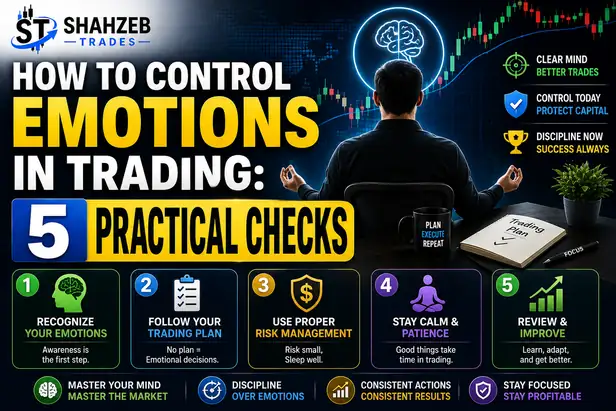
This guide explains How to Control Emotions in Trading through five practical checks that can be used before, during, and after a trading session.
How to Control Emotions in Trading: The Real Goal
How to Control Emotions in Trading does not mean forcing yourself to feel calm all the time.
A better objective is to notice the emotion, identify the action it is encouraging, and then compare that action with your predefined rules.
For example, fear might encourage you to close a position before your planned exit. Greed might encourage you to increase exposure. Frustration might push you toward revenge trading. FOMO may convince you that you must enter immediately.
Investor.gov discusses behavioral patterns such as active trading, momentum behavior, and other decision-making biases that can interfere with investment decisions. Investor.gov behavioral patterns bulletin
The market itself cannot be controlled. Your preparation and response can be controlled.
That is the foundation of How to Control Emotions in Trading.
Why Emotions Affect Trading Decisions
Trading combines uncertainty with financial risk, which can make ordinary price movements feel unusually important.
Suppose a trader enters a position and immediately watches the floating loss. A small price movement against the position may feel much larger when the position size is uncomfortable.
The trader then makes a decision:
“I need to move the stop.”
The original risk plan has changed.
Another trader takes a losing trade and immediately searches for another opportunity because the previous loss feels unacceptable.
The new trade may have nothing to do with the original strategy.
This is why emotional control is closely connected to risk management. The CFTC advises forex traders to determine how much risk capital they can use and to develop a risk-management plan before participating in leveraged forex trading. CFTC forex guidance
A well-defined risk management plan can reduce the amount of uncertainty you have to manage during the trade.
Learning How to Control Emotions in Trading therefore starts before you click Buy or Sell.
5 Practical Checks for How to Control Emotions in Trading
1. Check Your Risk Before Entry
The first step in How to Control Emotions in Trading is making sure the amount at risk is something you can handle.
Position size affects psychology.
If every small candle creates significant financial pressure, you may find yourself watching the trade differently. You may close early, move the stop, or constantly check the account balance.
Instead, define the risk before entry.
A simple framework is:
Account size → planned risk → stop distance → position size
For example, suppose a trader has a $2,000 account and chooses a predefined 1% risk level.
The planned risk would be:
$2,000 × 1% = $20
The exact position size still depends on the instrument, pip value, stop distance, and account currency. The important part is that the trader knows the intended risk before opening the position.
CME Group’s position-sizing guidance connects position size with account size, stop distance, and the amount a trader is prepared to risk. CME Group position-sizing guidance
A manageable risk level can make it easier to think clearly while the trade is active.
2. Check the Setup, Not Your Feelings
A trader can feel nervous about a good setup and excited about a poor one.
Neither emotion tells you whether the trade meets your rules.
Before entry, ask:
- Is the setup present?
- Does it match my strategy?
- Is the entry level valid?
- Is the stop placed at a logical invalidation point?
- Is the position size within my risk rule?
- Would I still take this trade if my last trade had a different result?
That final question is powerful.
After two losses, you may feel afraid to enter.
After three wins, you may feel unusually confident.
The setup itself has not necessarily changed.
CME Group’s trade-plan education emphasizes establishing trading rules and criteria in advance rather than relying on decisions made under pressure. CME trade-plan guidance
This makes How to Control Emotions in Trading less about motivation and more about following evidence-based rules.
3. Create a Rule for Revenge Trading
Revenge trading often begins with one thought:
“I need to make that loss back.”
That thought changes the purpose of the next trade.
Instead of asking whether the next setup is valid, the trader starts asking how quickly the previous loss can be recovered.
That can lead to:
- Larger position sizes
- Lower-quality setups
- Immediate re-entry
- More trades than planned
- Moving stops
- Trading outside the normal session
Create a rule before the emotion appears.
For example:
After reaching my daily loss limit, I stop opening new trades until my next planned session.
Another useful rule:
A losing trade does not automatically justify increasing position size.
The objective is not to predict exactly when revenge trading will appear. The objective is to create a barrier between the feeling and the order.
That is a practical part of How to Control Emotions in Trading because the decision has already been made when you are calm.
4. Journal the Emotion and the Action
A trading journal should not only record entry, exit, profit, and loss.
To improve How to Control Emotions in Trading, record what happened internally and what you did because of it.
For each trade, note:
- Setup type
- Entry time
- Planned risk
- Position size
- Stop distance
- Reason for entry
- Reason for exit
- Emotion before entry
- Emotion during the trade
- Whether a rule was followed or broken
After enough trades, patterns can become obvious.
Maybe FOMO appears mostly during fast markets.
Maybe you move stops after the first losing trade.
Maybe you trade outside your normal session when you are bored.
Maybe you close positions early whenever a profitable trade starts retracing.
Those are useful observations because each behavior can have a specific response.
A trading tools workflow can also help organize your checklist and journal.
5. Use a Clear Stop-Trading Rule
Sometimes How to Control Emotions in Trading means knowing when not to trade.
A trader who is already frustrated may continue searching for another setup even when the original trading plan says to stop.
Create conditions that end the session.
They might include:
- Reaching your maximum daily loss
- Breaking a major trading rule
- Taking several impulsive trades
- Losing focus
- Feeling pressure to recover a previous loss
- Trading outside the planned session
The exact conditions should fit your own trading plan.
The important point is that a stop-trading rule should be decided before the emotional moment.
CME’s educational material on trading psychology also emphasizes recognizing personal barriers and using planning to make trading decisions more structured.
A Practical Trading Example
Imagine a trader begins the session with a $2,000 account and has a predefined $20 risk for each planned trade.
The first valid setup appears.
The trader enters.
The trade reaches the stop.
The first emotion is frustration.
The next chart shows another possible setup, but it does not fully match the strategy.
The trader now has two options.
Option A: Enter with a larger size because the previous trade lost.
Option B: Skip the trade and wait for the next valid setup.
Option B does not guarantee a better result. What it does is keep the next decision independent from the previous loss.
Later, a valid setup appears.
The trader takes it using the same risk framework.
The second trade may win or lose. Either result is acceptable within the planned process.
This example shows how How to Control Emotions in Trading works in practice: emotion can be present without controlling the next action.
How to Control Emotions in Trading During a Losing Streak
How to Control Emotions in Trading becomes especially important after several consecutive losses.
A losing streak can create fear about taking the next setup. It can also create the opposite reaction: an urge to take larger risk to recover faster.
Neither reaction should automatically change the plan.
Instead, review:
- Were the trades valid?
- Was the planned risk respected?
- Were stops placed according to the strategy?
- Did market conditions change?
- Did emotional decisions cause any of the losses?
- Is the strategy being judged from a meaningful sample rather than a handful of trades?
If the trades followed the plan, a losing streak does not automatically mean the strategy needs immediate changes.
If the losses came from repeatedly breaking rules, the problem may be execution rather than the strategy itself.
That distinction matters when learning How to Control Emotions in Trading because it prevents one difficult session from becoming a reason for impulsive changes.
Build a Daily Emotional-Control Routine
A simple routine can make emotional control easier.
Before Trading
Write down:
Today’s setup:
What conditions am I waiting for?
Today’s risk:
How much am I prepared to risk?
Today’s stop point:
What conditions make me stop trading?
Today’s emotional warning:
What behavior do I need to avoid?
During Trading
Before every entry, take a short pause.
Ask:
“Am I following my plan, or am I trying to change the last result?”
That single question can expose revenge trading, FOMO, and overconfidence.
After Trading
Review the session.
Score three things:
Plan followed: Yes / No
Risk followed: Yes / No
Emotional interference: Low / Medium / High
Then write one sentence:
“The main behavior I need to improve is ______.”
This keeps the review specific.
It also makes How to Control Emotions in Trading measurable instead of turning it into a vague instruction to “stay calm.”
Common Emotional Trading Mistakes
Moving a Stop Because the Loss Feels Uncomfortable
If the stop represents the original invalidation point, moving it simply because price is getting closer changes the trade’s risk.
Chasing a Fast Move
A fast candle can create FOMO. Entering after the planned setup has already passed can produce a completely different trade.
Increasing Size After a Win
A winning streak can create overconfidence. Position size should change because of a predefined rule, not because recent trades felt easy.
Trading to Recover
The market does not know that you lost money earlier in the day.
A recovery objective can turn the next trade into an emotional decision rather than a strategy-based decision.
Watching Profit and Loss Constantly
Repeatedly checking the account balance can make normal price movement feel more significant.
Focus on the setup, risk rules, and planned exit rather than reacting to every small change in floating P&L.
FAQs
How to Control Emotions in Trading when I feel afraid?
How to Control Emotions in Trading starts with reducing the decision pressure before entry. Define the risk, stop, and entry conditions in advance. If the setup meets your plan but you still feel nervous, follow the predefined rules rather than changing them simply because the trade feels uncomfortable.
Why do I become emotional after a losing trade?
A losing trade can create an urge to avoid another loss or recover the previous amount quickly. That pressure can lead to revenge trading, larger position sizes, or impulsive entries. A predefined loss limit and cooling-off rule can help separate the next decision from the previous result.
How can I stop revenge trading?
Set the rule before the next loss. For example, stop opening new positions after reaching your predefined daily loss limit. Also avoid increasing position size solely because the previous trade lost. The purpose is to create a pause between the emotion and the next trade.
Does position size affect trading emotions?
Yes. A position that feels financially too large can make ordinary price movements feel more stressful. Defining risk before entry and adjusting position size to your stop distance can make the trade easier to manage according to the original plan.
Can a trading journal improve emotional discipline?
A journal can help identify repeated connections between emotions and actions. Recording when you felt fear, frustration, FOMO, or overconfidence—and what you did afterward—creates evidence that can be reviewed later. This makes it easier to target specific behaviors instead of simply trying to “be more disciplined.”
Should I stop trading when I feel angry?
If anger is causing you to ignore your risk rules, chase entries, move stops, or increase position size, stopping may be more appropriate than forcing another trade. Your trading plan can include emotional conditions that require you to end the session and review later.
Risk Disclaimer
Trading forex and other leveraged markets carries substantial financial risk. Emotional-control methods cannot remove market risk or guarantee a specific outcome. This article is for educational purposes only and is not personal financial advice. Use appropriate risk management, understand your broker’s terms and costs, and trade only with capital you can afford to lose.
Conclusion
How to Control Emotions in Trading is less about becoming perfectly calm and more about building a process you can follow when you are not calm.
Define your risk before entry.
Check the setup instead of your emotions.
Create a clear rule for revenge trading.
Record your emotional triggers.
Know exactly when you will stop trading.
The market will sometimes move differently from what you expected. That does not automatically require a new strategy, larger position, or immediate revenge trade.
Your job is to control the decisions that are actually within your control.
That is the practical answer to How to Control Emotions in Trading: prepare the rules while calm, recognize the emotion when it appears, and let the predefined process decide what happens next.